
If you have been dreaming of a career in Rajasthan’s prestigious administrative services, this is the moment you have been waiting for. The Rajasthan Public Service Commission (RPSC) officially released the RAS Recruitment 2026 notification on May 27, 2026, announcing a total of 607 vacancies for the Rajasthan State and Subordinate Services Combined Competitive Examination.
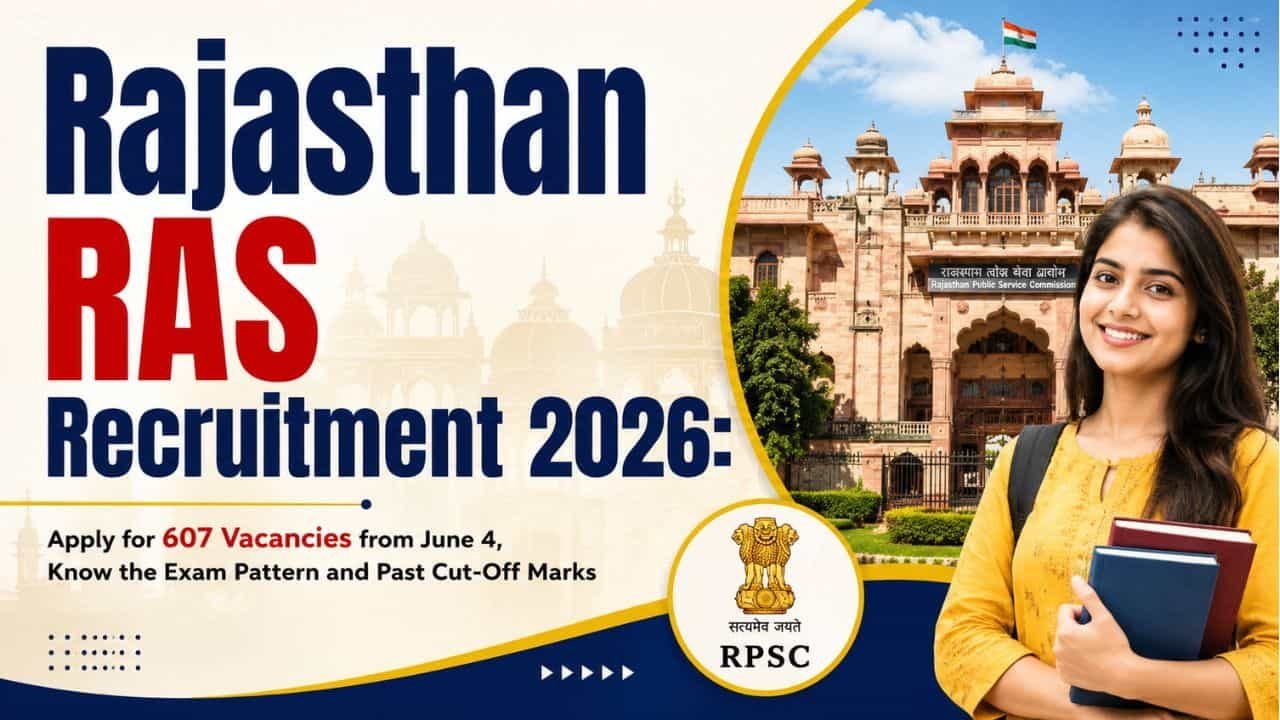
The online application window opened on June 4, 2026, giving aspirants a golden opportunity to secure one of the most coveted positions in state governance. Whether you are a first-time applicant or a seasoned RAS aspirant, this detailed guide covers everything you need to know — from eligibility and vacancies to exam pattern, syllabus, and year-wise cut-off analysis.
What Is the RAS Exam and Why Does It Matter?
The RAS (Rajasthan Administrative Service) examination is conducted by the Rajasthan Public Service Commission and is considered one of the most competitive state-level civil services examinations in India. Cracking the RAS exam opens doors to elite positions such as the Rajasthan Administrative Service officer, Rajasthan Police Service officer, Tehsildar, and several other Group A and Group B posts across state departments.
Officers selected through this examination are responsible for governance, law enforcement, revenue administration, and public welfare across districts and sub-divisions of Rajasthan. Given the prestige, job security, and salary that come with these posts, lakhs of graduates apply each year, making the competition intense and demanding.
RPSC RAS 2026: Key Highlights at a Glance
Before diving deeper, here is a quick summary of the most important details every aspirant must know right away.
- Conducting Body: Rajasthan Public Service Commission (RPSC)
- Exam Name: Rajasthan State and Subordinate Services Combined Competitive Examination 2026
- Notification Date: May 27, 2026
- Application Start Date: June 4, 2026
- Last Date to Apply: July 3, 2026
- Prelims Exam Date: November 29, 2026
- Total Vacancies: 607
- Official Website: rpsc.rajasthan.gov.in
Vacancy Breakdown: State Services vs Subordinate Services
Out of the total 607 vacancies, the posts are divided into two broad categories. The first is State Services with 192 posts, which includes top-tier positions like the Rajasthan Administrative Service (RAS) with 57 posts, Rajasthan Police Service (RPS) with 26 posts, Rajasthan Accounts Service, and other administrative roles.
The second is Subordinate Services with 415 posts, which includes positions such as Tehsildar, Excise Service officer, Cooperative Service officer, Jail Service officer, and several other department-level roles. Candidates who qualify through the same examination are allocated to these posts based on their rank, category, and preference.
Eligibility Criteria: Are You Qualified to Apply?
Educational Qualification
Any candidate holding a Bachelor’s degree (Graduation) in any discipline from a recognised university or an equivalent qualification is eligible to apply for RPSC RAS 2026. The degree must be from a university recognised by the University Grants Commission (UGC).
Age Limit
The minimum age requirement is 21 years and the maximum is 40 years, calculated as of January 1, 2027. Reserved category candidates receive age relaxation as per Rajasthan government norms. Candidates belonging to OBC (Non-Creamy Layer), SC, ST, and other horizontal reservation categories are entitled to additional years of relaxation.
Nationality
Applicants must be Indian citizens and should be domiciled in Rajasthan. Certain posts may have additional domicile requirements as specified in the official notification.
How to Apply Online for RPSC RAS 2026
The application process is entirely online and is handled through RPSC’s official website. Candidates must complete the One Time Registration (OTR) before filling out the application form. The OTR process auto-fetches your name, date of birth, father’s name, and gender directly from your Aadhaar or Jan Aadhaar card, so ensure your Aadhaar details are accurate before you begin. After completing OTR, log in to the RPSC portal, fill in the application form, upload documents, and pay the requisite fee. The last date to apply online is July 3, 2026, so do not delay.
RPSC RAS 2026: Selection Process and Exam Pattern
The selection process takes place in three stages, each progressively more challenging.
Stage 1: Preliminary Examination (Screening)
The Prelims is a screening test and is objective (MCQ) in nature. It consists of a single paper on General Knowledge and General Science. This stage is only qualifying in nature, meaning the marks scored here are NOT counted in the final merit list. Its only purpose is to shortlist candidates for the Mains exam. Approximately 15 times the total number of vacancies are shortlisted for the Mains.
| Details | Information |
| Number of Questions | 150 MCQs |
| Total Marks | 200 |
| Duration | 3 Hours |
| Negative Marking | 1/3 mark per wrong answer |
| Difficulty Level | Graduation Level |
| Nature | Qualifying/Screening only |
Stage 2: Mains Examination (Selective)
The Mains exam is descriptive and analytical in nature. It consists of four compulsory papers, each carrying 200 marks, for a combined total of 800 marks. The marks scored in the Mains are directly counted in the final merit list. Papers I, II, and III cover General Studies at graduation level, while Paper IV on General Hindi and English is at senior secondary level. Each paper contains short-answer, medium-answer, and long-answer questions. To qualify the Mains, a candidate must score at least 10% in each individual paper and at least 15% in the aggregate. SC/ST candidates get a relaxation of 5%.
| Paper | Subject | Marks | Duration |
| Paper I | General Studies I | 200 | 3 Hours |
| Paper II | General Studies II | 200 | 3 Hours |
| Paper III | General Studies III | 200 | 3 Hours |
| Paper IV | General Hindi and General English | 200 | 3 Hours |
| Total | 800 | 12 Hours |
Stage 3: Personality Test / Interview
Candidates who clear the Mains examination are called for a personality test commonly known as the Interview. This round carries 100 marks and evaluates the candidate’s communication skills, analytical thinking, confidence, awareness, and suitability for an administrative role. The final merit list is prepared by combining the Mains marks (800) and Interview marks (100), giving a total of 900 marks.
Syllabus Overview: What You Need to Study
Prelims Syllabus
The single Prelims paper covers a wide range of subjects. Rajasthan-specific topics carry significant weightage and include Rajasthan’s history, art and culture, folk traditions, saints, festivals, architecture, geography, economy, and political and administrative system. Indian topics include Indian history from ancient to modern period, Indian Constitution, political system, governance, Indian geography, Indian economy, and current national affairs. General topics cover world geography, science and technology, space and defence, environment and ecology, biodiversity, reasoning and mental ability, and current affairs with national and international importance.
Mains Syllabus
The four Mains papers are comprehensive. Paper I covers History (Rajasthan, Indian, and World), Geography (Rajasthan and India), Indian Economy, and Rajasthan Economy. Paper II focuses on Indian Constitution, Political System, Governance, Public Administration, Management Concepts, Ethics and Values, and Rajasthan’s Political and Administrative System. Paper III deals with Science and Technology, Reasoning and Aptitude, Environment and Ecology, Agriculture, IT and Computers, and Current Affairs. Paper IV tests proficiency in General Hindi and General English through grammar, comprehension, and essay writing. An important update in the 2026 revised syllabus is that the Sports and Yoga module has been removed, and all 2-mark questions have been replaced with 5-mark and 10-mark questions to emphasise analytical writing over rote recall.
Previous Year RAS Prelims Cut-Off Analysis (2017 to 2024)
Understanding past cut-offs is crucial for setting realistic preparation targets. The RAS Prelims is not held every year. In recent times, it was conducted in 2017, 2018, 2021, 2023, and 2024. The table in the Exam Pattern section above already covers marks structure. Below is a year-wise trend of General category (Male) Prelims cut-off out of 200 marks.
Year-wise General Category (Male) Prelims Cut-Off:
- 2017: 78.54 marks
- 2018: 76.06 marks (Non-TSP)
- 2021: 84.72 marks
- 2023: 100.69 marks
- 2024: 71.59 marks
The trend tells a very interesting story. Between 2017 and 2021, the General category male cut-off hovered steadily between 76 and 85, reflecting a consistently competitive but manageable benchmark. In 2023, however, the cut-off jumped sharply to over 100, largely because the paper was moderate in difficulty and 905 vacancies attracted an exceptionally high number of well-prepared candidates. Then in 2024, the cut-off dropped significantly to 71.59 because the paper was notably difficult, bringing the average scores down across all categories.
For female candidates, the General category cut-off in 2021 was 79.63 and in 2023 it was 97.01, showing a similar upward spike followed by correction. SC and ST candidates consistently see cut-offs 8 to 15 marks lower than the General category benchmark, while Widow and Ex-Serviceman horizontal reservation candidates qualify at significantly lower scores.
What Cut-Off Can Be Expected in RAS 2026?
Since the 2026 recruitment has only 607 vacancies compared to 905 in 2023, the competition per vacancy is higher. Based on past patterns, if the 2026 Prelims paper is of moderate difficulty, the General category male cut-off could realistically land between 90 and 105 marks. If the paper turns out to be difficult, it may drop to the 75 to 85 range. Candidates targeting a safe score should aim for at least 95 to 100 marks to stay above fluctuations. It is also worth noting that OBC and EWS cut-offs in 2023 matched the General category exactly, so aspirants from these categories should not lower their targets.
Salary and Benefits After Selection
One of the biggest draws of the RAS post is the compensation package. State Services officers are placed on Pay Matrix Levels L-12 to L-14, while Subordinate Services officers receive Pay Matrix Levels L-10 to L-11. In addition to the basic pay, selected candidates receive Dearness Allowance (DA), House Rent Allowance (HRA), Travel Allowance, Medical Benefits, and pension under the National Pension System (NPS). At the senior level, officers also get official vehicles, accommodation, and staff support, making it one of the most attractive government careers in Rajasthan.
Final Advice for RAS 2026 Aspirants
The RAS 2026 exam is a significant opportunity. With 607 posts, a clear syllabus, and the Prelims scheduled for November 29, 2026, aspirants have nearly six months to prepare from the application date. Use this time wisely. Focus heavily on Rajasthan-specific topics since they form the core of the Prelims paper. Current affairs from the past 12 months must be covered without fail. For Mains, practice answer writing regularly because descriptive questions demand structure, clarity, and depth.
Avoid negative marking in Prelims by not attempting questions you are unsure about. Apply before the deadline of July 3, 2026, at rpsc.rajasthan.gov.in and keep your OTR registration details ready.
The RAS journey is demanding but deeply rewarding. Begin your preparation today and give yourself the best chance of joining Rajasthan’s administrative backbone.

2 thoughts on “Rajasthan RAS Recruitment 2026: Apply for 607 Vacancies from June 4, Know the Exam Pattern and Past Cut-Off Marks”