
Searching for tissues in action class 9 notes to revise before your exam? This guide covers the full Ch 3 Tissues in Action class 9 notes syllabus in a simple, diagram-based format, so you don’t need a separate tissues in action class 9 notes pdf to understand each concept. Whether you usually study from tissues in action class 9 notes in Hindi resources or compare with platforms like tissues in action class 9 notes edurev, these visual notes make every idea easy to follow. From what a tissue is to how plants keep growing non-stop, everything is explained step by step below.
What is a Tissue?
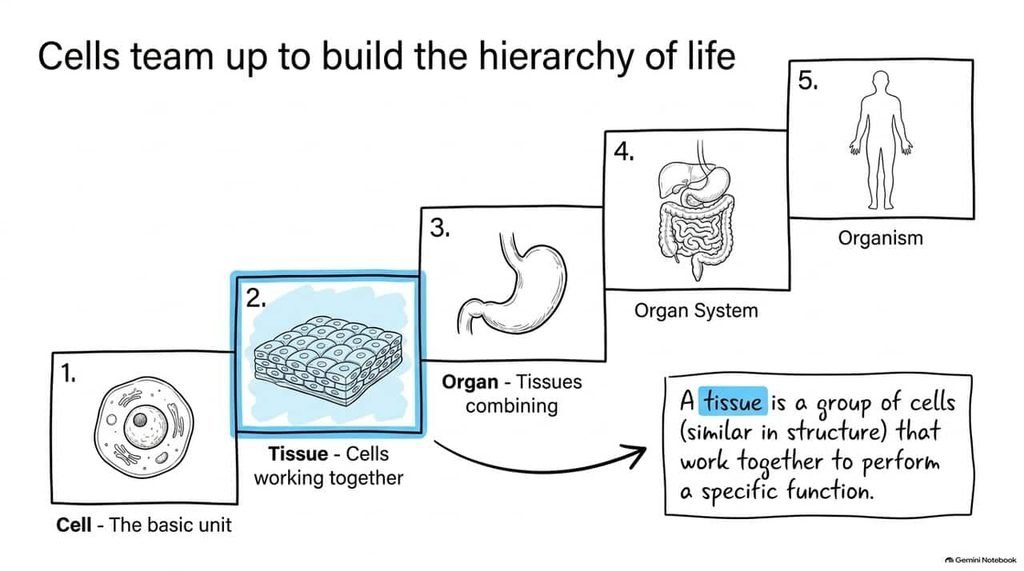
Think about how a house is built. Bricks make a wall, walls make a room, rooms make the house. Living things are built in a very similar way, just with cells instead of bricks.
A single cell is the smallest working unit of life. But a cell rarely works alone in a big organism. Cells of the same kind sit together and share one job, and that group is called a tissue. Tissues then join to form an organ (like the stomach), organs team up to form an organ system (like the digestive system), and all the systems together make one complete organism.
In simple words: a tissue is a group of similar cells doing one specific job together. The muscle in your arm is a good example. Thousands of muscle cells contract at the same time, and that is what lets you lift a bag.
Why Do Living Things Need Tissues?
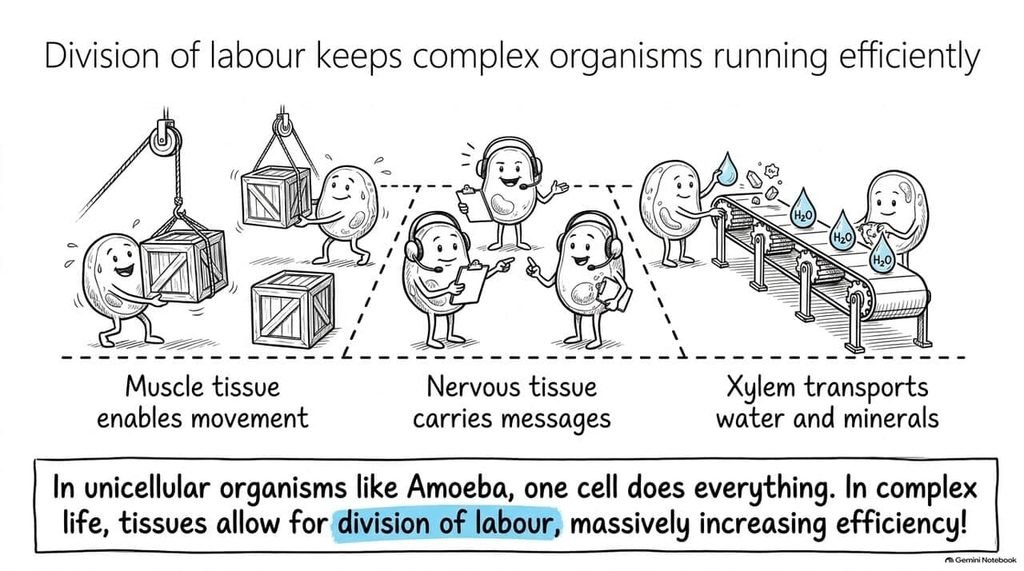
Imagine a small tea stall run by one person. He buys the milk, makes the tea, serves it, and collects the money. It works because the shop is tiny. This is how an Amoeba lives: one cell does everything, from moving and eating to reproducing.
Now imagine a big restaurant. There is a chef, a waiter, and a cashier, and each person does one job really well. Nobody is trying to do everything, so the whole restaurant runs faster.
Complex organisms work like that restaurant. Tissues allow division of labour, where each tissue gets one job:
- Muscle tissue handles movement.
- Nervous tissue sends messages between the brain and the body.
- Xylem in plants carries water and minerals from the roots upward.
Because every tissue is a specialist, the organism becomes far more efficient than a single cell trying to manage everything alone.
Plants and Animals: Different Lifestyles, Different Tissues
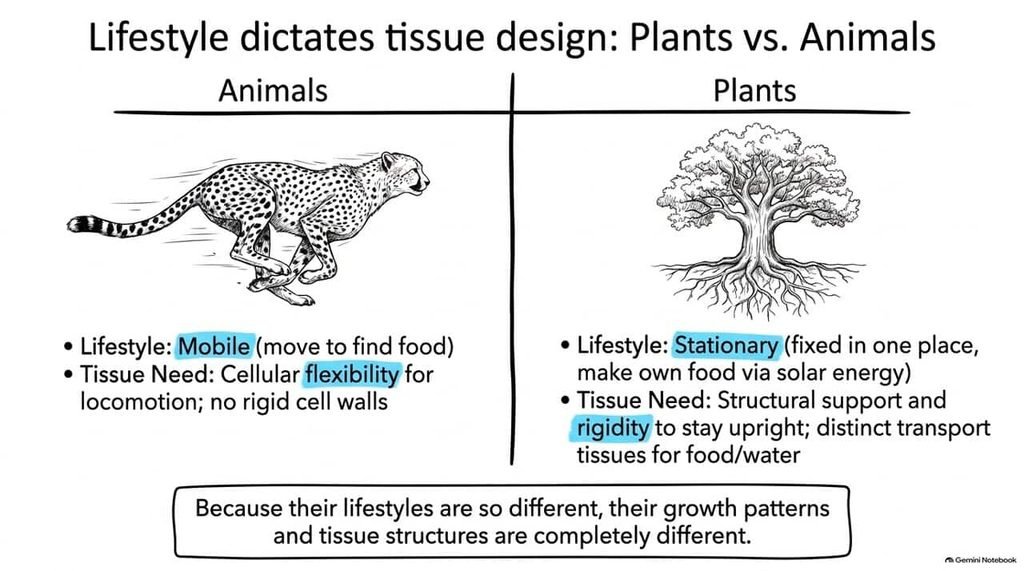
Picture a cheetah and a banyan tree. The cheetah has to chase its food, so its body must be flexible and quick. The banyan tree stays in one spot for hundreds of years, so it must stand firm against wind and rain, and it must make its own food using sunlight.
This one difference in lifestyle explains almost everything about their tissues.
| Question | Animals | Plants |
|---|---|---|
| Can they move around? | Yes, they travel to find food | No, they stay fixed in one place |
| How do they get food? | By hunting or searching | By making it using sunlight |
| What kind of body is needed? | Flexible, without rigid cell walls | Strong and rigid to stay upright |
| What special tissues are needed? | Tissues that help in movement | Separate tissues to carry water and food |
So when you see that plant and animal tissues look very different, remember the reason: their way of life is very different.
How Do Plants Keep Growing?
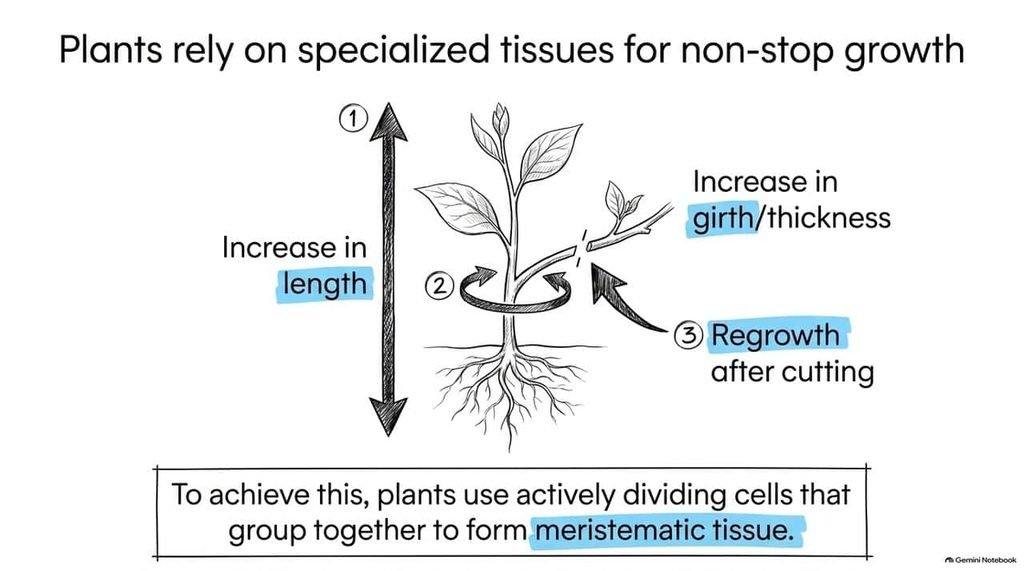
Most animals grow only until they reach a certain size. Plants are different. A tree keeps growing for its whole life, and it does this in three ways:
- It grows taller. Stems reach upward and roots push deeper.
- It grows thicker. The trunk becomes wider every year.
- It regrows after damage. A cut branch or a trimmed hedge can grow back.
But a plant cannot grow from every part of its body. Growth happens only in certain special regions, where cells keep dividing again and again. A group of such actively dividing cells is called meristematic tissue. You can think of it as the growth factory of the plant.
The Onion Root Experiment (You Can Try It at Home)
How do we know that growth happens only in special regions? Here is a simple activity that shows it.
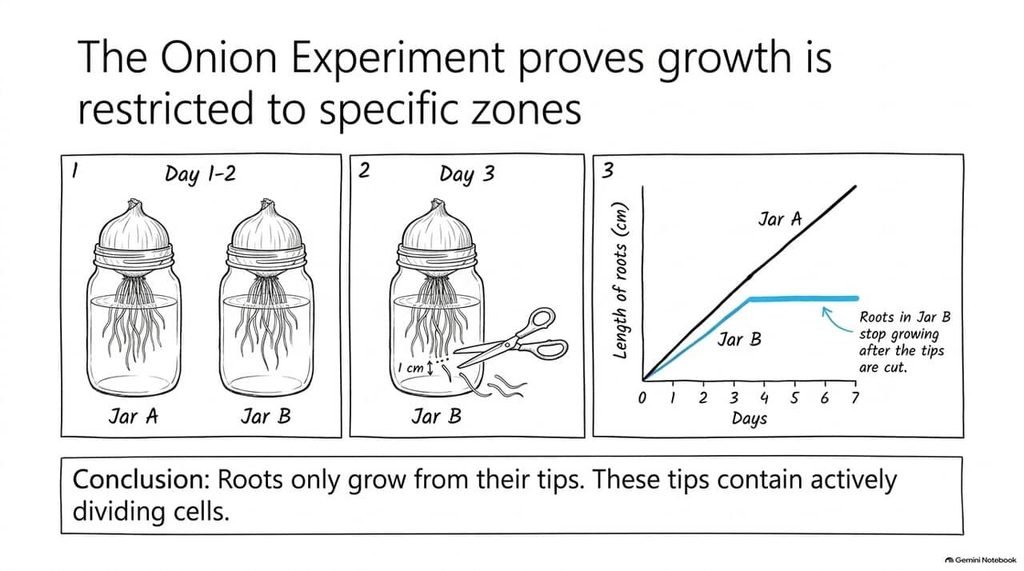
What you need: two onions, two jars filled with water.
Steps:
- Place one onion on top of each jar so that the base of the onion just touches the water. Label them Jar A and Jar B.
- Wait for two days. Roots will start growing in both jars.
- On Day 3, cut about 1 cm off the tips of the roots in Jar B only. Leave Jar A untouched.
- Measure the root length in both jars every day for the next few days and note it down.
What you will see: The roots in Jar A keep getting longer every day. The roots in Jar B almost stop growing after the tips are cut.
Why does this happen? The tips of the roots contain the dividing cells. When you cut the tips, you remove the cells that were making new growth. Without them, the root has no way to get longer.
The lesson is clear: roots grow from their tips, and the tips contain actively dividing cells.
Apical Meristem: The Part That Makes the Plant Longer
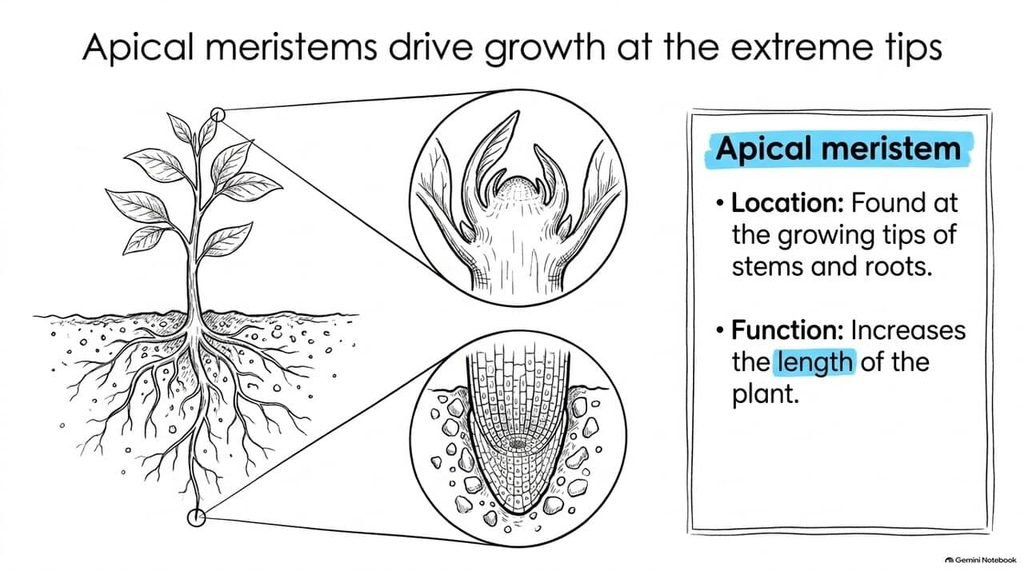
Imagine a ladder that gets longer only by adding new steps at the very top. That is how the apical meristem works.
It is found at the tips of stems and roots. At the shoot tip, it pushes the plant upward toward sunlight. At the root tip, it pushes the root deeper into the soil in search of water. In both cases, its job is the same: to increase the length of the plant.
Lateral Meristem: The Part That Makes the Plant Thicker
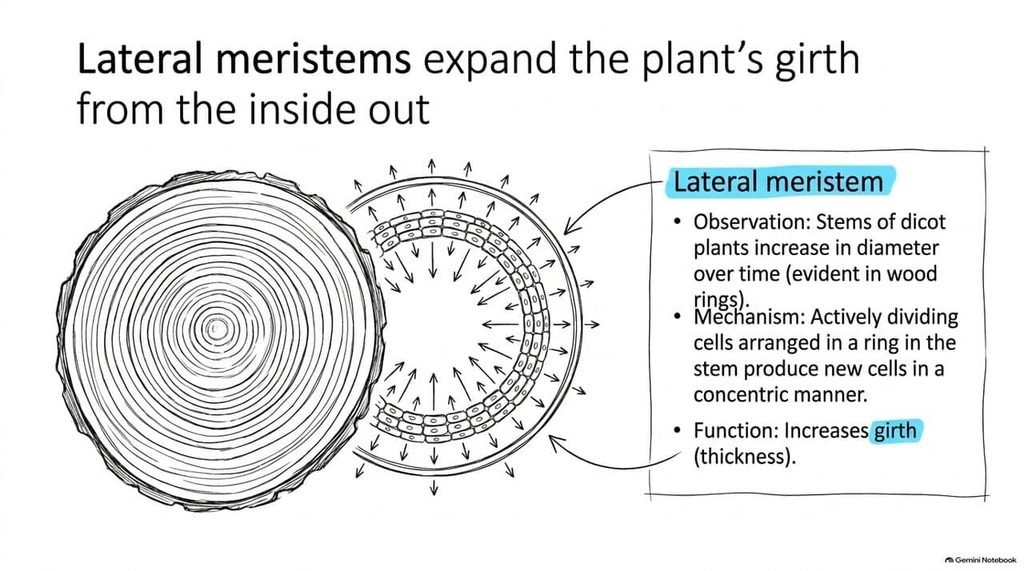
Have you ever seen a cut tree trunk with circles inside it? Those circles are called annual rings, and they exist because of the lateral meristem.
In the stems of dicot plants, a ring of dividing cells runs around the stem. These cells keep producing new cells in a circular pattern, so the stem slowly becomes wider over time. Its job is to increase the girth, or thickness, of the plant.
A fun fact for your exam answers: counting the rings of a trunk gives a rough idea of how old the tree is.
Intercalary Meristem: The Regrowth Helper
Think about a cricket ground or a lawn. The grass is cut short again and again, yet it turns green and tall within days. How does it survive when its tip keeps getting chopped off?
The answer is the intercalary meristem. Instead of sitting at the tip, it is located at the base of the leaves or at the nodes (the joints of the stem). Since it is low down, the mower or a grazing animal cannot reach it. After the top is cut, this hidden meristem keeps dividing and pushes out fresh growth.
This is why grass, and plants that are often eaten by animals, can recover so quickly.
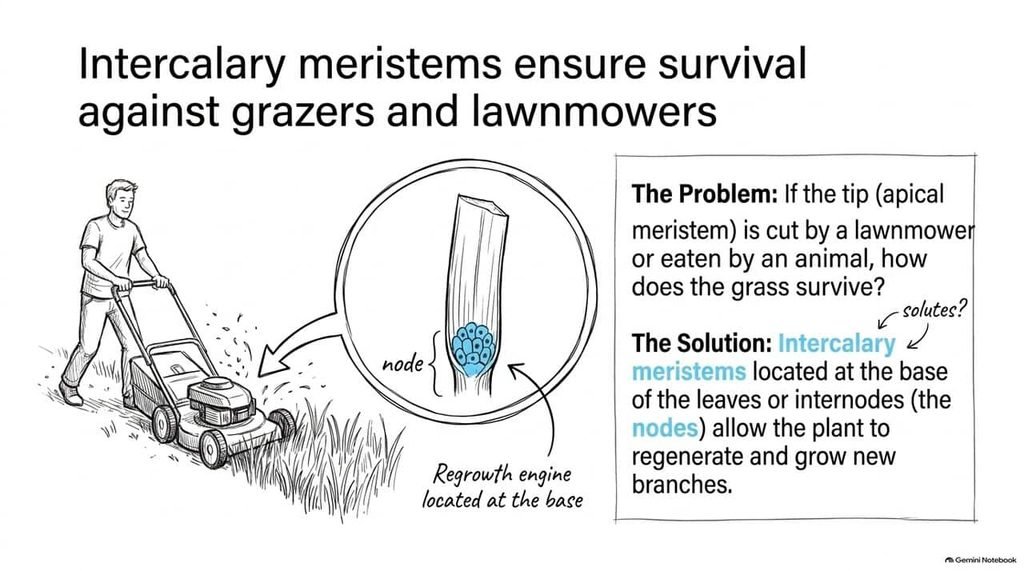
Three Meristems at a Glance
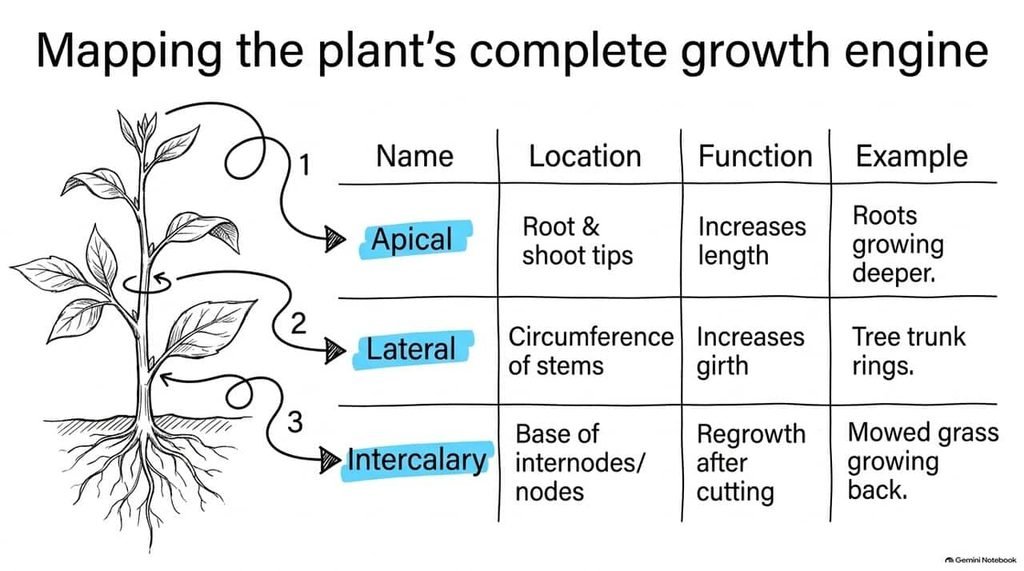
Here is a quick way to remember all three types together.
| Type | Where to look | What it adds | Easy memory trick | Real-life example |
|---|---|---|---|---|
| Apical | Tips of roots and shoots | Length | Apex means top or tip | Roots growing deeper |
| Lateral | Sides of the stem | Thickness (girth) | Lateral means side | Rings in a tree trunk |
| Intercalary | Base of leaves and nodes | Regrowth after cutting | Inter means in between | Mowed grass growing back |
Why Do Meristematic Cells Look the Way They Do?
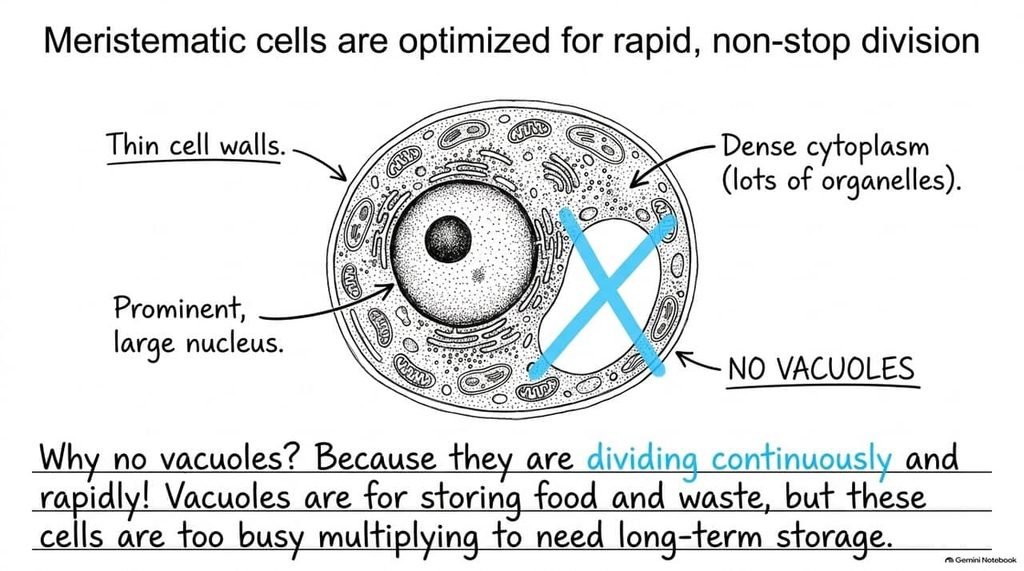
These cells have one full-time job: dividing again and again. Their structure is designed for exactly that.
- Thin cell walls: A thin wall is easy to split, so the cell can divide quickly.
- Large, prominent nucleus: The nucleus is the control room of the cell. A busy, dividing cell needs a big control room to give constant instructions.
- Dense cytoplasm: The cytoplasm is packed with organelles, like a workshop full of machines ready to build new material.
- No vacuoles: This one is a common exam question.
Why no vacuoles? Vacuoles are storage spaces for food and waste. A cell that is dividing continuously and rapidly is far too busy making new cells to worry about long-term storage. So it simply does not keep a big storage room.
Differentiation: From Dividing Cells to Permanent Specialists
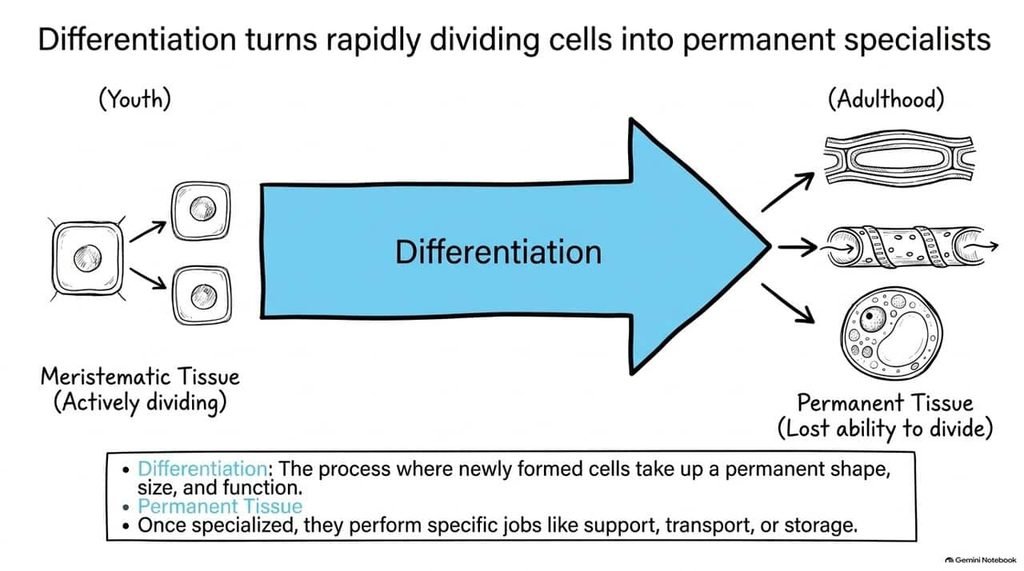
Meristematic cells are like students. They are young, flexible, and still deciding what to become. But at some point they have to choose a career.
When newly formed cells settle into a fixed shape, size, and function, the process is called differentiation. Once this happens, the cell has become part of a permanent tissue. Just like a person who becomes a doctor does not go back to being a student, these cells lose the ability to divide.
Permanent tissues then take up specific jobs such as support, transport, or storage for the rest of the plant’s life.
So the journey is simple: meristematic tissue (youth, actively dividing) turns into permanent tissue (adulthood, specialized and settled).
Tissues in Action: How Plants and Animals Solve Survival Problems
Every living thing faces the same everyday problems. It has to stay protected, stand firm, and get water and food to every corner of its body. In this part of the chapter, we will see which tissue solves which problem, first in plants and then in animals.
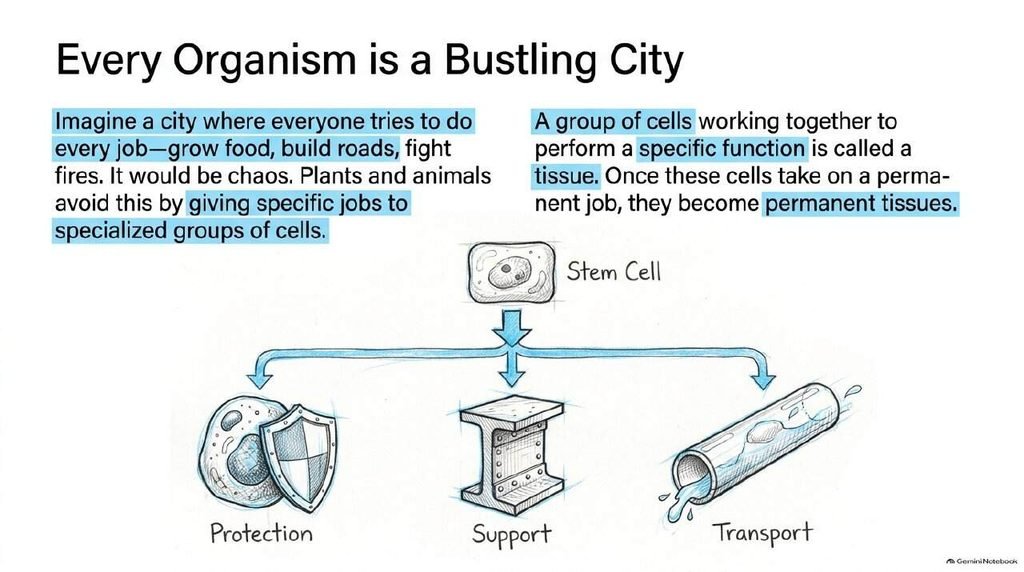
Every Organism Works Like a Busy Railway Station
Picture a big railway station where one man tries to sell tickets, sweep the platforms, guard the gate, and carry luggage all at once. Trains would run late and passengers would be stuck everywhere. A real station runs smoothly because every group has its own job.
Living things follow the same idea. Specialized groups of cells take up separate jobs such as protection, support, and transport. As you already know, a group of cells working together for a specific function is a tissue. When these cells settle into a fixed, permanent job, they form permanent tissues.
You can think of a young, unspecialized cell (a stem cell) as a fresh recruit. Depending on the training it gets, it can become a protector, a supporter, or a transporter.
Problem 1: How Does a Plant Protect Itself?
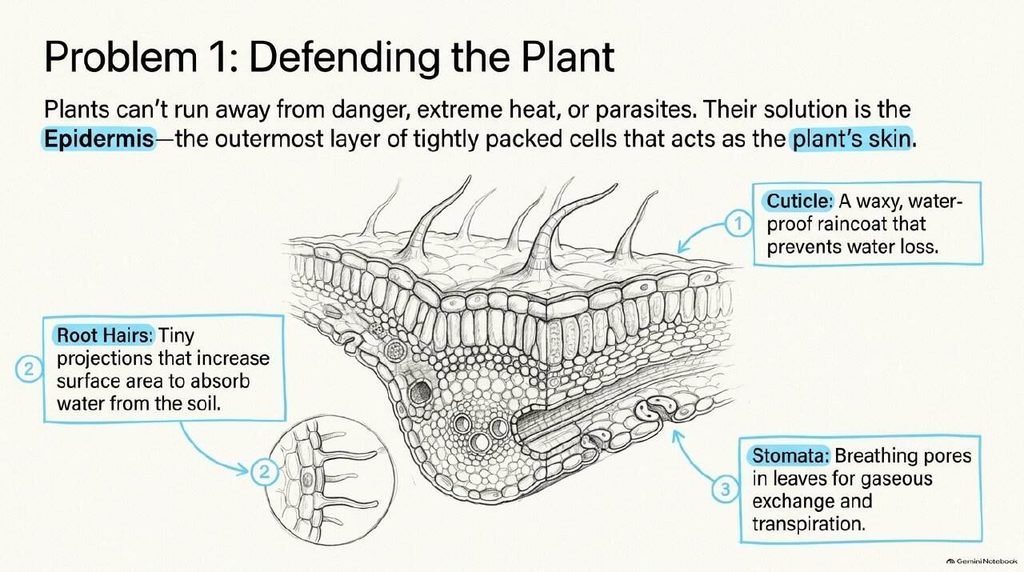
A plant cannot run away from a scorching afternoon, a hungry insect, or a parasite. So its outer covering has to do all the defending. This covering is the epidermis, usually a single layer of tightly packed cells. Think of it as the skin of the plant.
The epidermis has three clever features:
- Cuticle: A waxy, waterproof coating, just like a raincoat. It stops the plant from losing too much water. Desert plants have an especially thick one.
- Root hairs: Tiny outgrowths on the root surface. Imagine thousands of tiny straws. They increase the surface area so the root can absorb more water from the soil.
- Stomata: Small breathing pores on leaves. They let gases move in and out (gaseous exchange) and let water vapour escape (transpiration). Each pore is controlled by two bean-shaped guard cells that open and close it.
Did you know? In older stems and roots, the epidermis is replaced by cork, a dead protective layer with thick walls.
Mapping the Plant: Three Tissue Systems
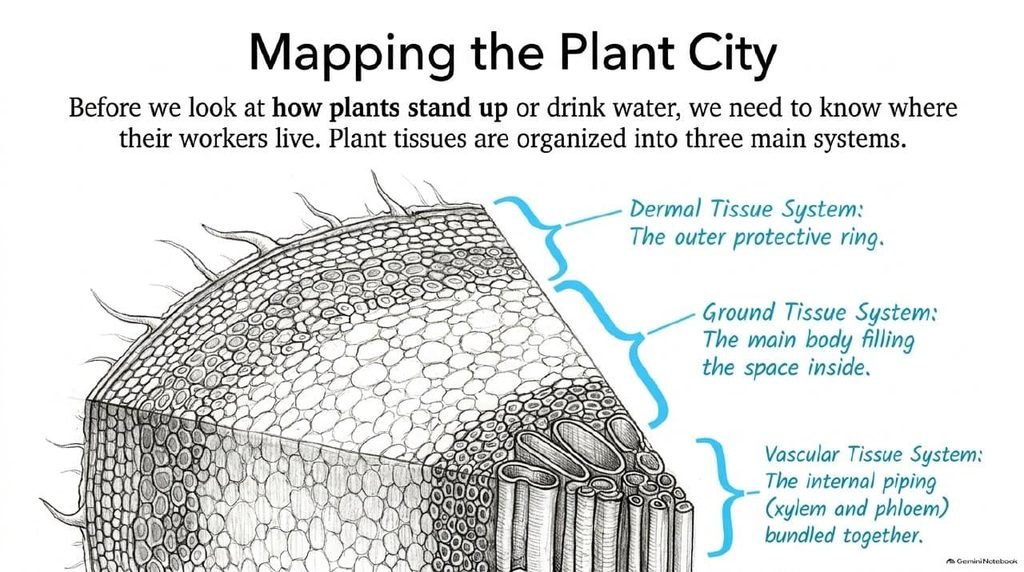
Before we learn how plants stand tall and drink water, let us find out where all the workers live. Plant tissues are organized into three systems.
| Tissue system | Where it sits | Simple way to picture it |
|---|---|---|
| Dermal | The outer layer | The boundary wall with security guards |
| Ground | The space filling the inside | The main rooms of the building |
| Vascular | Bundles running through the plant | The water and food pipelines |
The vascular system is made of xylem and phloem bundled together, and we will meet them shortly.
Problem 2: How Does a Plant Bend Without Breaking?
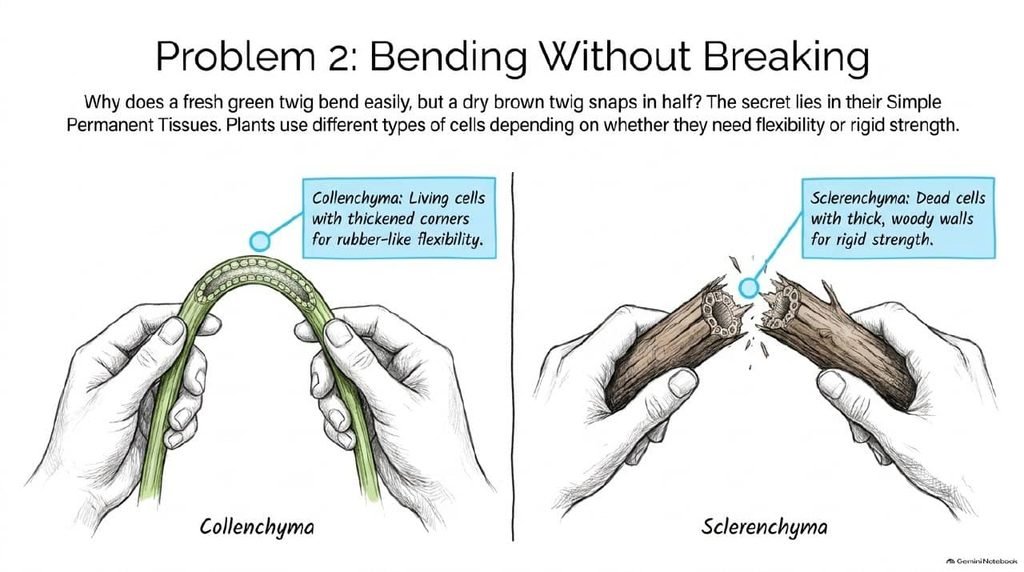
Here is a quick activity. Bend a fresh green twig, and it bends easily. Now try a dry brown twig, and it snaps with a crack. Why?
The answer lies in simple permanent tissues, which are made of just one type of cell. Plants use different types depending on whether a part needs flexibility or strength.
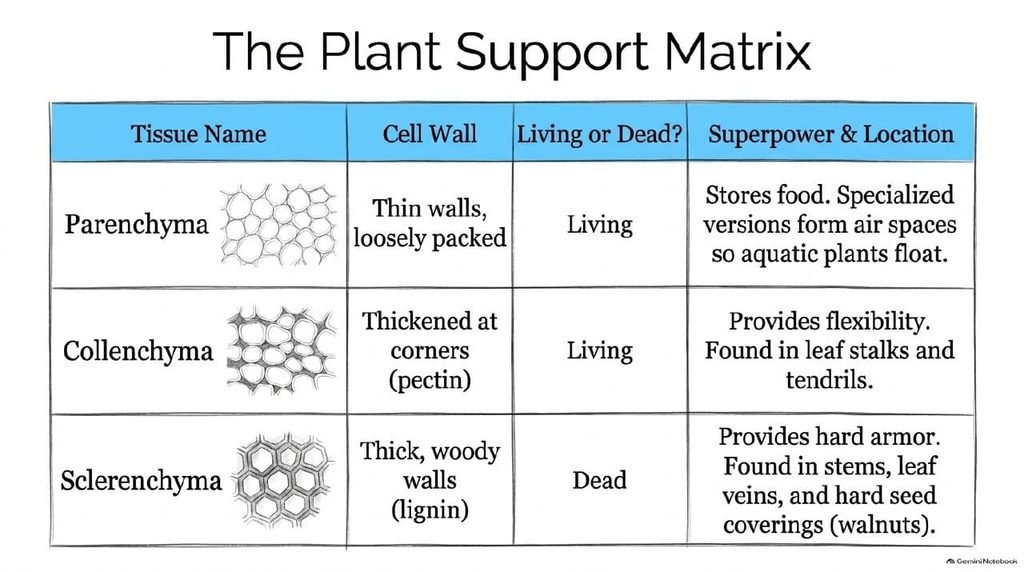
- Collenchyma: These are living cells whose corners are thickened. It works like a rubber band, giving flexibility. This is why leaf stalks and tendrils can bend in the wind without tearing.
- Sclerenchyma: These are dead cells with thick, woody walls. It works like a steel rod, giving rigid strength. This is why the dry twig snaps instead of bending.
Parenchyma, Collenchyma and Sclerenchyma Compared
There is a third simple permanent tissue too: parenchyma. Its cells are living, thin-walled, and loosely packed, and their main job is to store food. Special versions of parenchyma have big air spaces inside, which helps water plants float. Some parenchyma cells also contain chloroplasts and carry out photosynthesis.
Here is an easy table with memory hooks for your exams.
| Tissue | Memory hook | Alive or dead? | Where you can find it |
|---|---|---|---|
| Parenchyma | P for Pantry (stores food) | Alive | Storage areas of the plant, floating parts of water plants |
| Collenchyma | C for Curvy (bends easily) | Alive | Leaf stalks and tendrils |
| Sclerenchyma | S for Stiff (hard and strong) | Dead | Stems, leaf veins, hard seed coverings like walnut shells and coconut husk |
Exam tip: collenchyma gets its thickened corners from pectin, while sclerenchyma has thick walls made of lignin.
Problem 3: The Plant’s Plumbing System
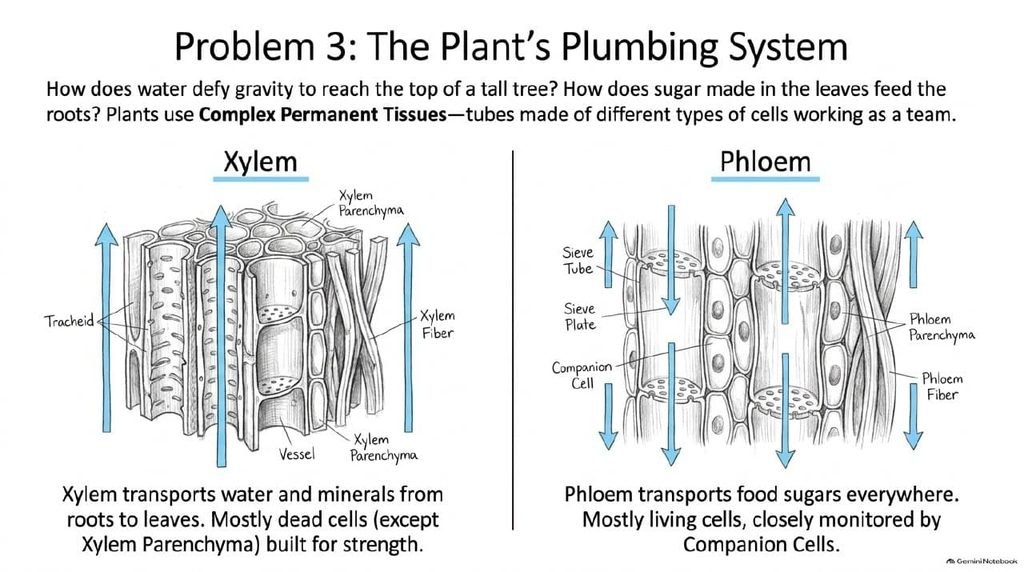
In your home, a pump sends water up to the overhead tank. But a tall tree has no pump. So how does water reach the topmost leaf? And how does the sugar made in the leaves reach the roots?
Plants solve this with complex permanent tissues. These are made of different types of cells that work together as a team. There are two of them: xylem and phloem.
Xylem is the water pipeline. It carries water and minerals from the roots up to the leaves. It is made of tracheids, vessels, xylem parenchyma, and xylem fibres. Most of its cells are dead, which makes them strong hollow tubes. The only living part is xylem parenchyma.
Phloem is the food delivery network. It carries the food (sugar) made in the leaves to every part of the plant. It is made of sieve tubes, companion cells, phloem parenchyma, and phloem fibres. Sieve tubes have tiny holes in their end walls called sieve plates. Most phloem cells are living, and companion cells keep a close watch on the sieve tubes.
| Feature | Xylem | Phloem |
|---|---|---|
| What it carries | Water and minerals | Food (sugars) |
| Direction of flow | Upward, from roots to leaves | Up and down, wherever food is needed |
| Cells alive or dead? | Mostly dead (except xylem parenchyma) | Mostly living |
| Helper cells | Tracheids and vessels | Sieve tubes and companion cells |
Moving to the Animal Kingdom
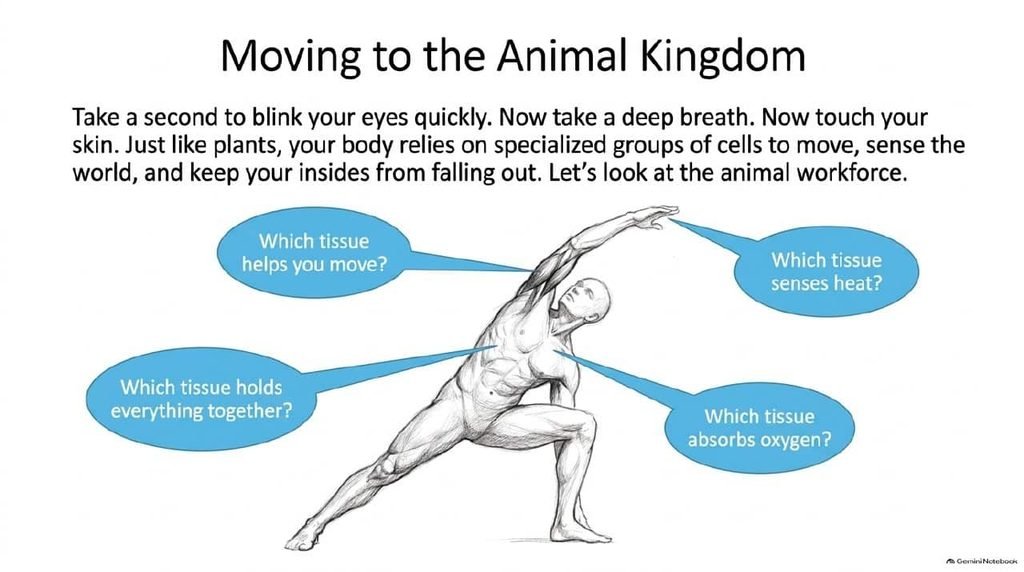
Blink your eyes quickly. Take a deep breath. Now touch your skin. Just like plants, your body depends on specialized cells to move, to sense the world, and to keep your insides from falling out!
Let us test your guesses:
- Which tissue helps you move? Muscle tissue
- Which tissue senses heat? Nervous tissue
- Which tissue holds everything together? Connective tissue
- Which tissue absorbs oxygen? Epithelial tissue
These are the four main animal tissues. In this part, we look closely at epithelial and connective tissue.
Problem 4: Shielding the Body With Epithelial Tissue
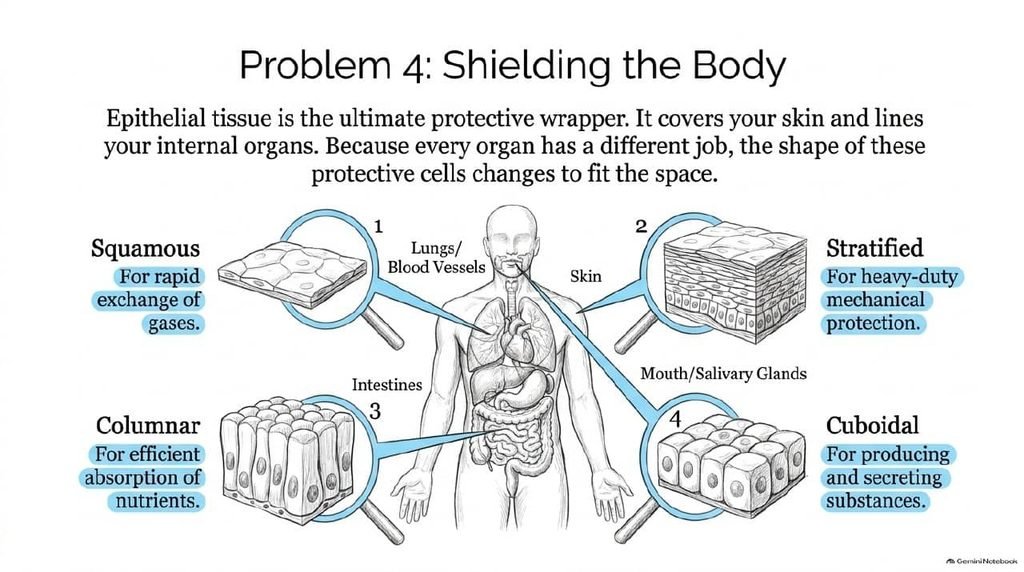
Epithelial tissue is the protective wrapper of the body. It covers your skin and also lines your internal organs. Its cells are packed very tightly with almost no gaps, so it forms a proper barrier. Anything that enters or leaves the body has to pass through it.
But every organ has a different job, so the shape of these cells changes to fit the space.
| Type | What the cells look like | Where it is found | Why this design works |
|---|---|---|---|
| Squamous | Flat and very thin | Lungs, blood vessels | A thin layer lets gases pass through rapidly |
| Stratified | Many layers stacked up | Skin | Layers act like a thick coat against rubbing and damage |
| Columnar | Tall and pillar-like | Intestines | Tall cells give more room to absorb nutrients |
| Cuboidal | Cube-shaped | Salivary glands | Suited for producing and releasing substances |
Problem 5: Tying the Body Together With Connective Tissue
If epithelial tissue is the wrapper, connective tissue is the glue and the highway system. It connects different parts, supports the body, and carries materials from one place to another.
The two examples to remember are:
- Bone: A solid, hard connective tissue.
- Blood: A fluid, flowing connective tissue.
There are other members of this family too. Tendons join muscle to bone, ligaments join bone to bone, and cartilage gives smooth, flexible cushioning in places like the nose, ears, and joints.

Blood and Bone: Why Both Are Connective Tissue
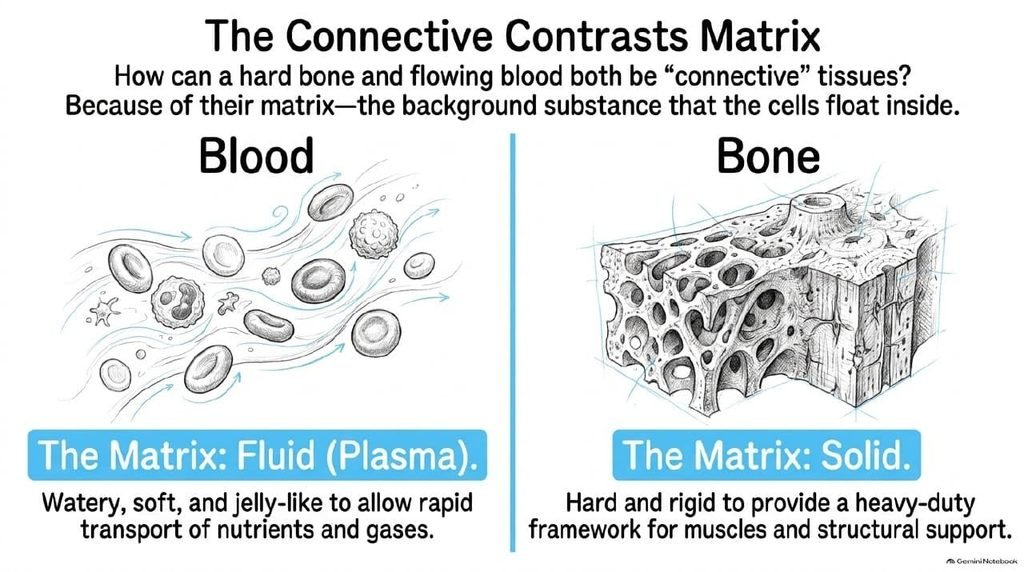
Here is a puzzle. Bone is hard and blood is liquid. How can both belong to the same family?
The secret is the matrix. This is the background substance in which the cells sit. Imagine fruit pieces floating in jelly and fruit pieces set inside a block of concrete. The fruit is similar, but the background makes them behave very differently.
| Blood | Bone | |
|---|---|---|
| Matrix | Fluid (plasma) | Solid |
| Feel | Watery, soft, jelly-like | Hard and rigid |
| Main job | Fast transport of nutrients and gases | Strong framework that supports the body and the muscles |
The Body in Action: What Your Blood Does When Life Happens
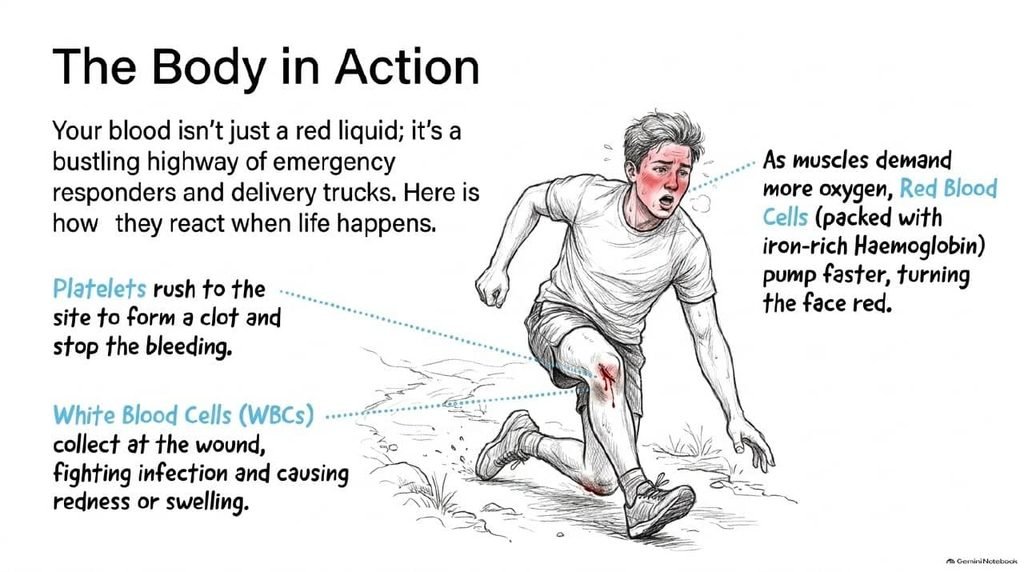
Blood is not just a red liquid. It is a busy transport network with delivery riders and emergency responders. Imagine you are running and you fall and scrape your knee. Three things happen together:
- Oxygen supply goes up. Your muscles demand more oxygen, so the heart beats faster and sends more blood around. Red blood cells, packed with iron-rich haemoglobin, carry the oxygen to the muscles. Extra blood also flows near the skin, which is why your face often turns red while running.
- Platelets stop the bleeding. They rush to the wound and form a clot.
- White blood cells fight germs. They gather at the wound to fight infection. That is why the area can look red or swollen.
Decoding Blood: Plasma, Red Cells, White Cells and Platelets
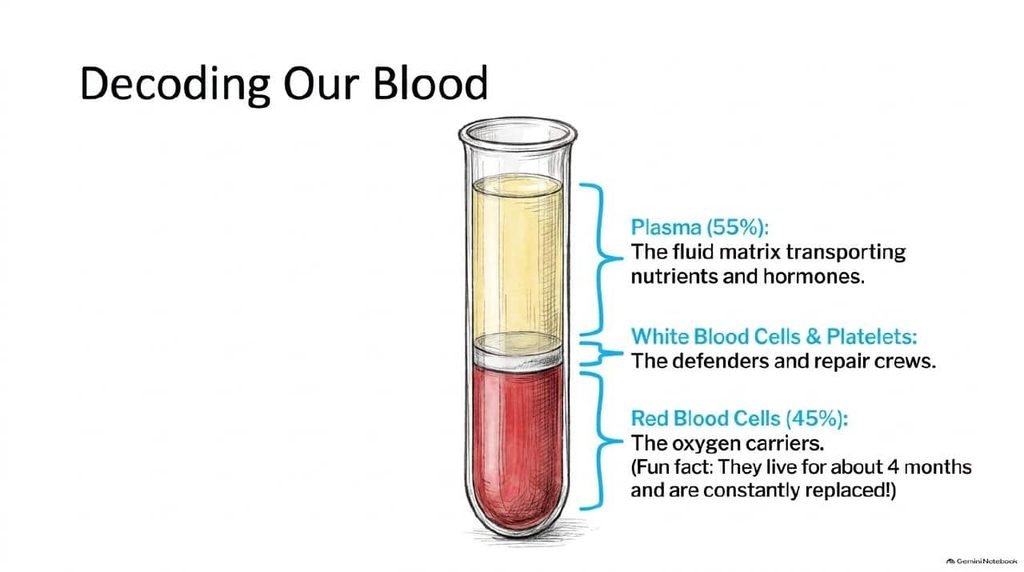
If you keep a blood sample in a test tube and let it settle, it separates into layers. At the top is a yellowish liquid, at the bottom a deep red layer, and in between a thin whitish line.
| Part | Share of blood | Job | Easy way to remember |
|---|---|---|---|
| Plasma | About 55% | Fluid matrix that carries nutrients and hormones (and also dissolved wastes) | The river that carries everything |
| Red blood cells | About 45% | Carry oxygen | Courier riders delivering oxygen parcels |
| White blood cells | Thin layer in between | Defend the body against germs | Security guards |
| Platelets | Thin layer in between | Form clots at wounds | Repair mechanics |
Fun fact: red blood cells live for only about 4 months, so the body keeps replacing them all the time.
The Big Picture: Plants and Animals Solve the Same Problems
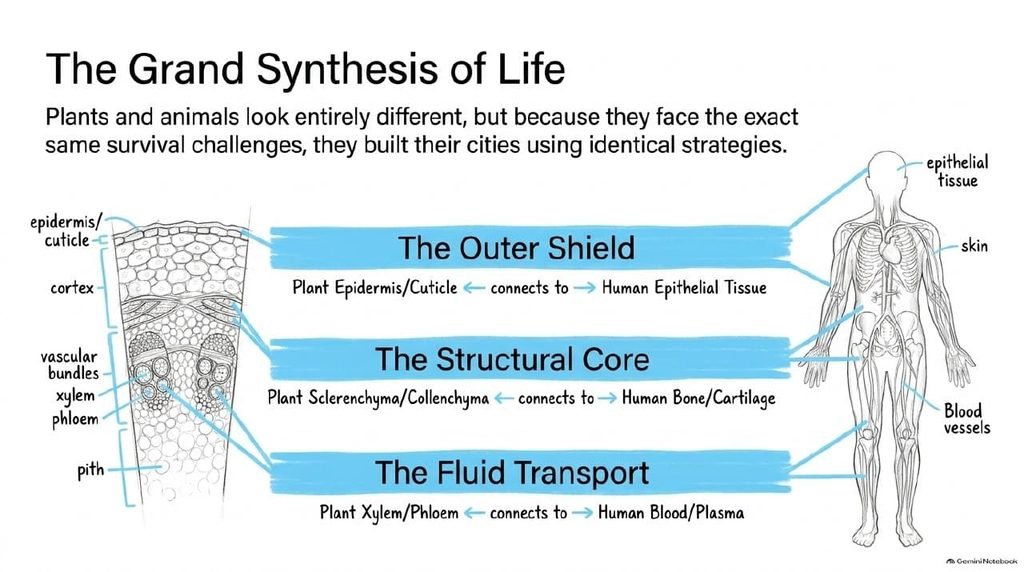
Plants and animals look completely different. But since they face the same survival challenges, they ended up using very similar strategies to build their bodies.
| Survival problem | In plants | In humans |
|---|---|---|
| The outer shield (protection) | Epidermis and cuticle | Epithelial tissue and skin |
| The structural core (support) | Sclerenchyma and collenchyma | Bone and cartilage |
| The fluid transport (delivery) | Xylem and phloem | Blood and plasma |
Here is a handy trick. Sclerenchyma is hard, like bone. Collenchyma is flexible, like cartilage. Different bodies, same clever solutions!
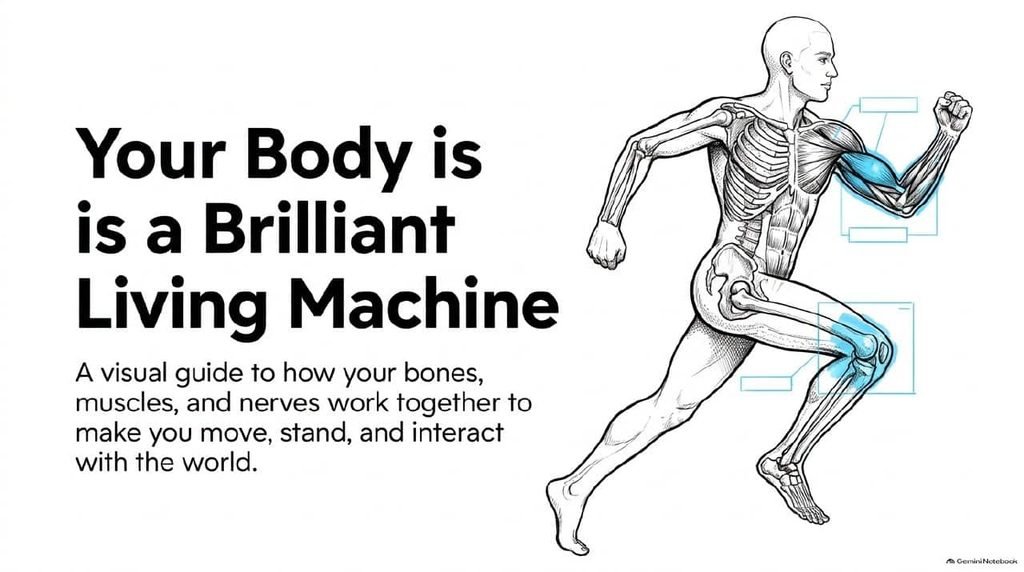
Your Body Is a Brilliant Living Machine
Stand up and take one step forward. That simple action needs a command from your brain, a signal through your nerves, a pull from your muscles, and a hinge in your knee to bend correctly. In this last part, we bring everything together and look at how the nervous system, muscles, bones, and joints work as one connected machine.
The Brain Sends the First Signal
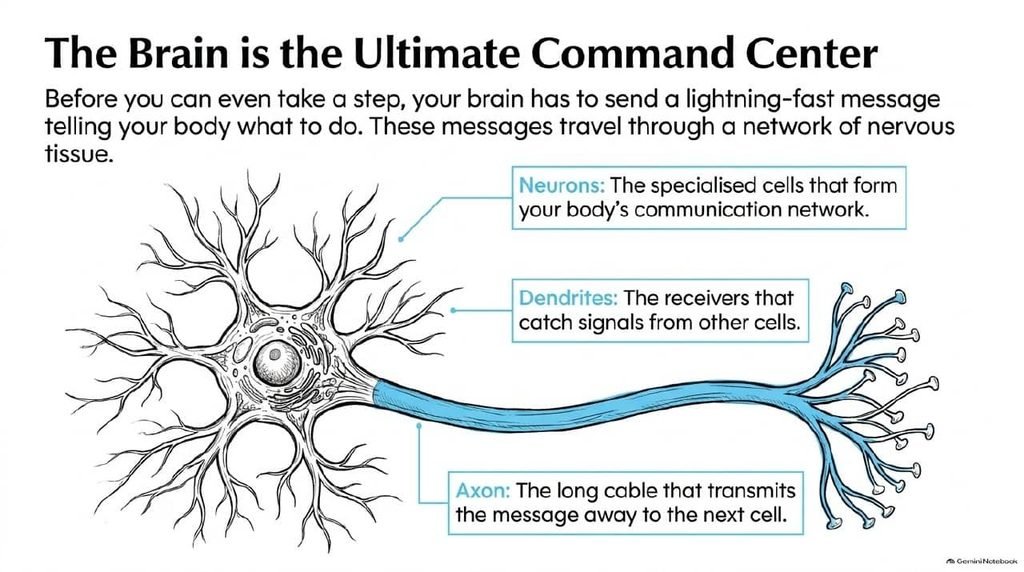
Before your foot even lifts off the ground, your brain has already sent an instruction. That instruction travels like an electric current through a network of nervous tissue, and it moves so fast that you never even notice the delay.
The message is carried by a special cell called a neuron. A neuron is not shaped like a normal round cell. It looks more like a tree with branches on one side and a long wire on the other.
- Dendrites: These are the branches. They act as receivers, catching signals coming in from other neurons.
- Axon: This is the long wire, sometimes stretching from your spinal cord all the way down to your toe. It carries the message forward to the next cell.
Think of a neuron as a mini courier office. Dendrites are the counter where messages arrive, and the axon is the delivery van that rushes the message to its destination.
Muscles Turn Signals Into Movement
A bone cannot move by itself. It has no engine of its own. It needs something to pull it, and that something is muscle.
Muscles work in two very different ways:
- Voluntary movements: These are actions you consciously decide to do, like running, writing, or lifting a bag. You are in full control.
- Involuntary movements: These happen automatically, without you ever thinking about them, like food moving through your intestine or your heart beating. Your body manages these on its own, day and night.
This is a bit like the difference between driving a car yourself and sitting in a self-driving car. In one case you control every turn, in the other, the system handles it in the background.

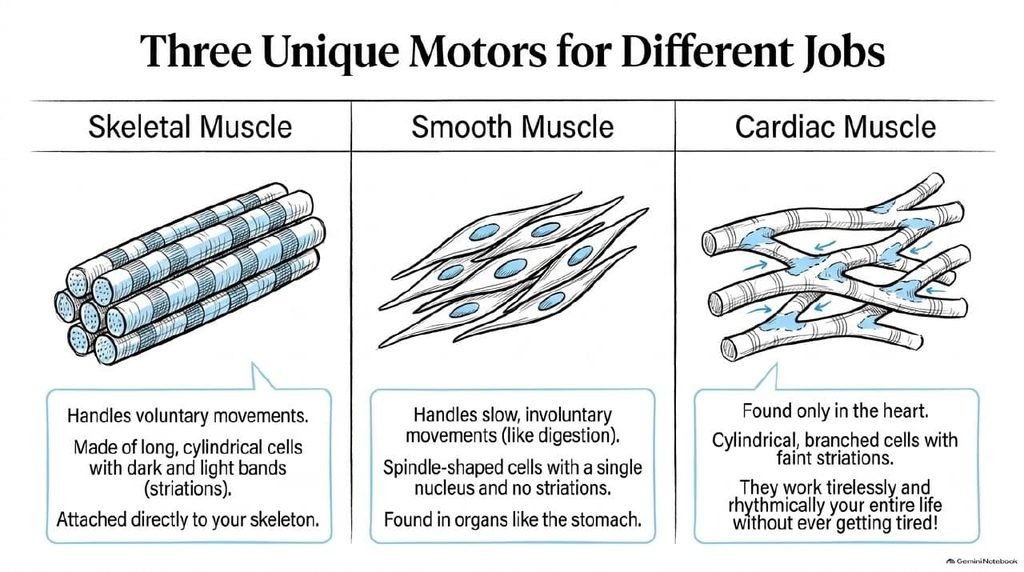
Three Types of Muscle, Three Different Jobs
Not all muscles are built the same way, because they are not doing the same job. There are three types.
| Muscle type | Cell shape | Job | Where to find it | Easy way to remember |
|---|---|---|---|---|
| Skeletal | Long, cylindrical, with visible stripes (striations) | Voluntary movement | Attached to bones, like the arm and leg | Think of it as the “gym muscle” you can flex |
| Smooth | Spindle-shaped, pointed at both ends, single nucleus, no stripes | Slow involuntary movement | Walls of organs like the stomach and intestine | Smooth because it looks plain, with no stripes |
| Cardiac | Branched and connected in a network, faint stripes | Constant rhythmic pumping | Found only in the heart | The muscle that never takes a break, not even while you sleep |
A fun way to test this yourself: flex your bicep, that is skeletal muscle at work. Feel your pulse on your wrist, that rhythm comes from cardiac muscle pumping blood.
Bone and Cartilage: The Framework With Shock Absorbers
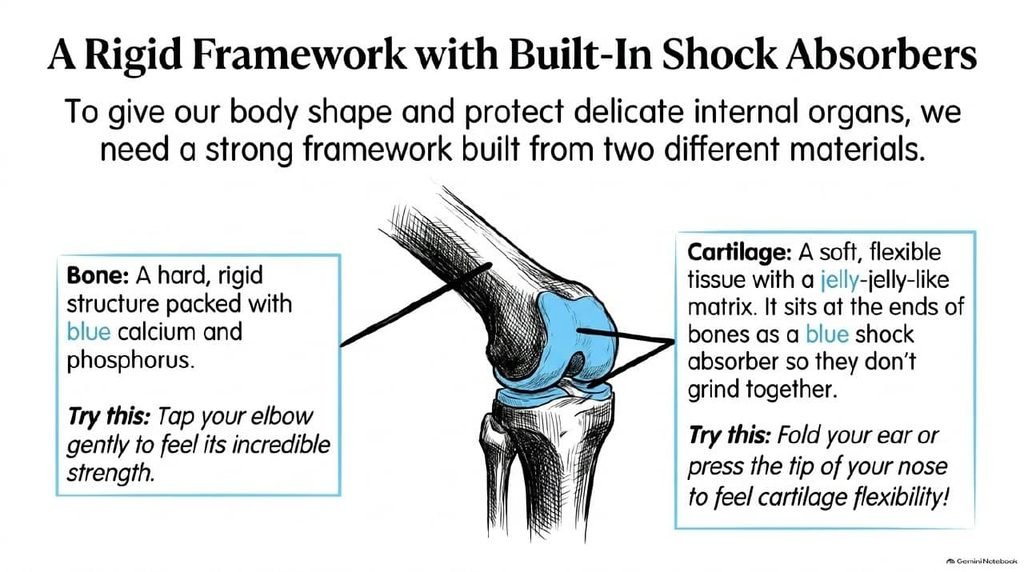
Your body needs a strong frame to hold its shape and protect soft organs inside, a bit like the steel frame inside a building. But a frame made only of hard material would crack easily wherever two parts meet. So the body uses two different materials together.
- Bone: A hard, rigid tissue packed with calcium and phosphorus. Gently tap your elbow and you can feel just how solid it is.
- Cartilage: A softer, flexible tissue with a jelly-like matrix. It sits at the ends of bones like a cushion, so they do not grind against each other. Fold the top of your ear or press the tip of your nose, and you are feeling cartilage right now.
Bone gives strength, cartilage gives cushioning, and together they let your skeleton be both sturdy and comfortable to move in.
Tendons and Ligaments: The Ropes That Hold the Machine Together
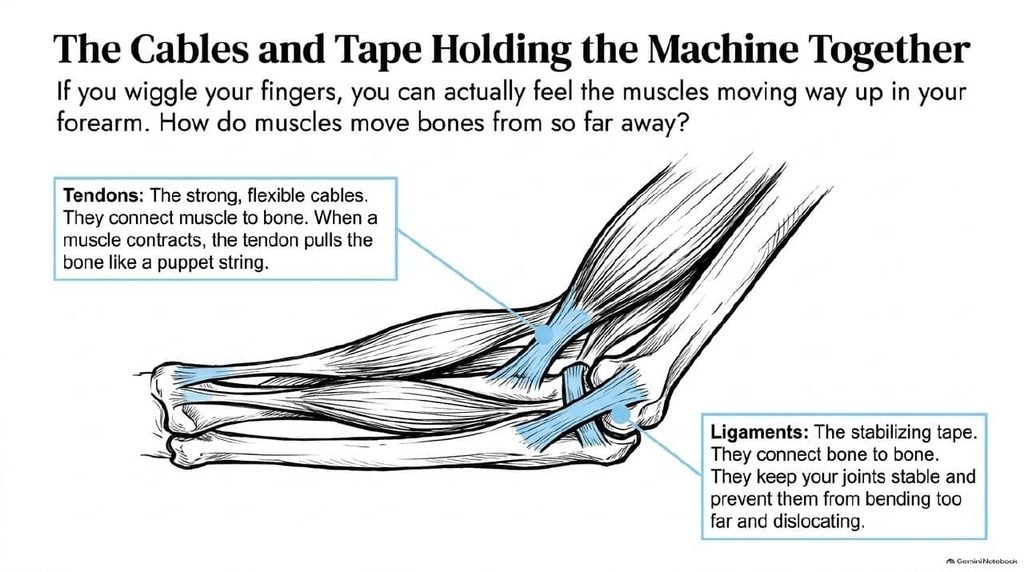
Wiggle your fingers slowly and you will feel movement way up near your wrist and forearm. That is because many of the muscles that move your fingers are actually anchored much higher up, and thin ropes carry the pull all the way down.
- Tendons: Strong, flexible cords that connect muscle to bone. When a muscle contracts, the tendon pulls the bone like someone tugging a puppet string.
- Ligaments: Slightly stretchy bands that connect bone to bone. Their job is to keep joints stable and stop them from bending too far and slipping out of place.
A simple way to remember the difference: Tendon connects muscle to bone (think Tug), and Ligament connects bone to bone (think Lock).
Bone, Cartilage, Tendon and Ligament at a Glance
Here is a table that puts all four connective tissues side by side, so revision becomes quick before an exam.
| Tissue | What it feels like | Main job |
|---|---|---|
| Bone | Hard, like a brick | Gives strength, support, and protection |
| Cartilage | Soft and springy, like a rubber cushion | Absorbs shock and prevents grinding |
| Tendon | A strong, twisted rope | Connects muscle to bone to create movement |
| Ligament | A tough, linked chain | Connects bone to bone and limits extra movement |

Surprising Fact: Muscles Weigh More Than Bones
Most students guess that bones make up most of a person’s body weight, since the skeleton feels so solid. The real numbers say otherwise.
An adult skeleton is only about 12 to 15 percent of total body weight. Active muscles carry the real load, making up about 40 to 50 percent of body weight in males and about 30 to 40 percent in females.
So the next time someone calls bones the heaviest part of the body, you will know the muscles are actually doing the heavy lifting, quite literally.

Joints: The Hinges That Make Bending Possible
Try to bend a wooden ruler in the middle. It will not bend, and if you force it, it snaps. Bones behave the same way, they are rigid and cannot bend on their own.
So how does your elbow fold? The body solves this with joints, the points where two or more bones meet. A joint allows movement to happen, but it cannot move a bone by itself. It only provides the hinge point, while the muscle attached nearby supplies the actual pulling force.

Joints Built for Maximum Freedom
Some parts of your body need to move in many directions at once, almost like a robot arm that can swing anywhere. Two special joints make this possible.
- Ball and socket joint: Found in the shoulder. A rounded knob at the top of the arm bone fits into a bowl-shaped socket. This design allows the arm to move forward, backward, sideways, and even in a full circle, like a joystick.
- Pivot joint: Connects the skull to the top of the backbone. It works much like a doorknob turning in its socket, and it is exactly what lets you shake your head side to side to say “no.”

Joints Built for Protection and Stability
Not every joint is meant for wide movement. Some are built mainly for safety and steady support.
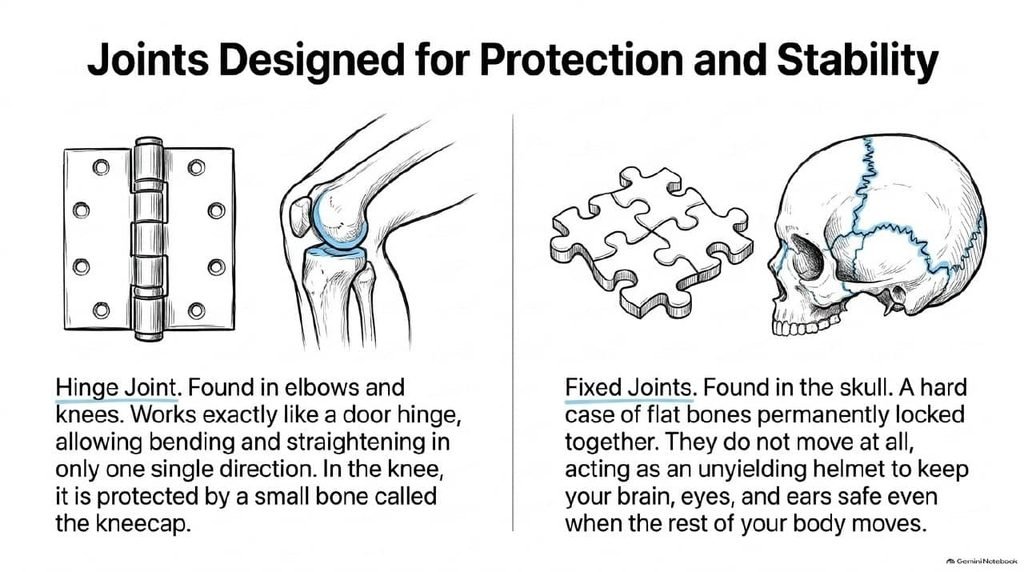
- Hinge joint: Found in the elbow and the knee. It works exactly like a door hinge, letting the joint bend and straighten in only one direction. In the knee, this hinge is protected in front by a small bone called the kneecap.
- Fixed joint: Found in the skull. Several flat bones lock together permanently, forming a hard case that never moves. It acts like a helmet, keeping the brain, eyes, and ears safe no matter how the rest of the body moves.
The Spine: A Flexible Central Pillar
If your backbone were one single, giant, stiff bone, you would never be able to bend forward or twist sideways. Instead, nature builds it out of many small bones called vertebrae, stacked one on top of the other from the base of the skull downward.
Between every pair of vertebrae sits a small cartilage disc, acting as a soft cushion. These discs are what let you bend and twist freely, while still protecting the delicate spinal cord running through the middle of the column.

The Rib Cage: A Protective Cage That Breathes
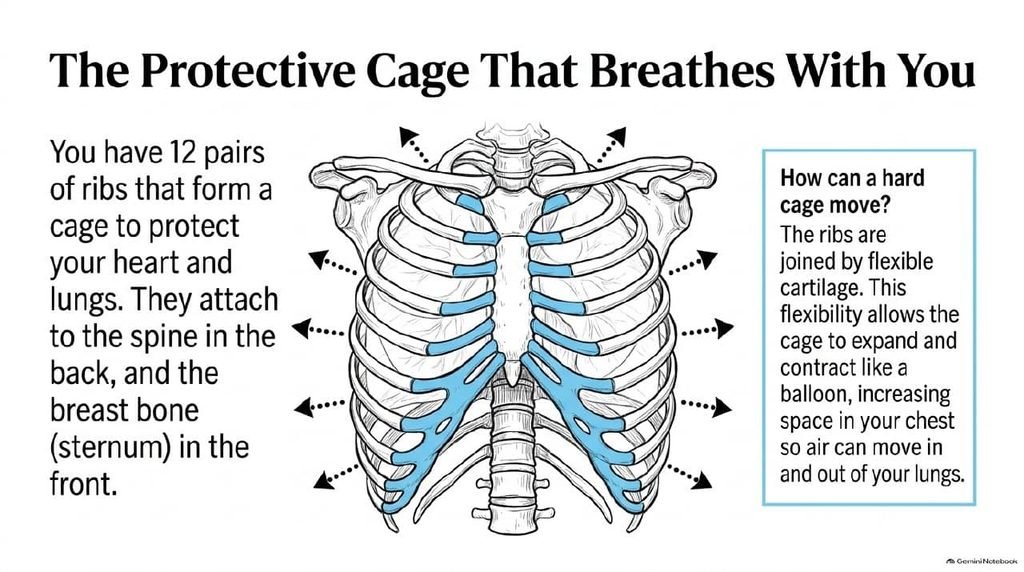
Your heart and lungs are soft and delicate, so the body wraps them in a protective cage made of 12 pairs of ribs. Each rib attaches to the spine at the back and to the breastbone (sternum) at the front.
Here is the clever part. If the cage were completely rigid, you would never be able to breathe, since breathing itself needs the chest to expand and contract. The ribs are joined to the sternum by flexible cartilage, which lets the whole cage move like a gently expanding balloon. This movement creates extra space in the chest so air can rush into the lungs, and it pushes air back out when you exhale.
The Whole System Working in Harmony
Watch someone move slowly through a stretch, a forward bend, or a lunge, and you can actually see the entire system working together in real time. The brain sends a signal down the nerves. Skeletal muscles contract and pull on their tendons. Joints pivot smoothly at exactly the right point, cushioned by cartilage so nothing grinds. Every part depends on every other part.
Staying active, keeping good posture, and eating well all help keep this remarkable machine working smoothly for a lifetime, and moving your body regularly is one of the simplest ways to keep muscles, bones, and joints in good shape.

Putting the Whole Machine Together
Here is the complete picture of how your body moves, from the first signal to the final step.
| Role | Tissue involved | What it does |
|---|---|---|
| Control | Brain and nerves | Sends the command to move |
| Power | Muscles (skeletal, smooth, cardiac) | Pulls bones and organs into action |
| Structure | Bone and cartilage | Gives shape, strength, and cushioning |
| Connectors | Tendons and ligaments | Link muscle to bone and bone to bone |
| Mobility | Joints (ball and socket, pivot, hinge, fixed) | Allow bending and turning at the right points |
Every one of these parts has one specific job, and together they let you stand, sense the world around you, and move exactly the way you intend to.

Quick Recap of the Full Chapter
- A tissue is a group of similar cells working together for one function, and tissues allow division of labour.
- Plant tissues include meristematic tissue for growth, and permanent tissues such as parenchyma, collenchyma, sclerenchyma, xylem, and phloem for storage, support, and transport.
- Animal tissues include epithelial tissue for protection, connective tissue for support and transport, muscle tissue for movement, and nervous tissue for control.
- Neurons carry messages, muscles create movement, bones and cartilage give structure, tendons and ligaments connect everything, and joints allow the structure to bend.
FAQs
Q1. Why can you move your fingers even though the muscles that control them are in your forearm, not your hand? Long tendons stretch from the forearm muscles down through the wrist and into the fingers. When a forearm muscle contracts, it pulls on its tendon, and the tendon transmits that pull all the way to the fingertip, just like tugging a string from a distance.
Q2. Why does your heart never get tired, even though it beats without stopping for your entire life? The heart is made of cardiac muscle, a special type found only in the heart. Its branched, connected cells are built to contract rhythmically and continuously, involuntarily, without ever needing rest the way skeletal muscle does.
Q3. Why don’t your knees or elbows move in a full circle like your shoulder does? The shoulder has a ball and socket joint, which allows movement in almost every direction. The knee and elbow have hinge joints instead, which only allow bending and straightening in one direction, similar to a door hinge. This design keeps these joints more stable during activities like walking and lifting.
Q4. If bones are so hard and rigid, how are you able to bend and twist your back? The backbone is not one solid bone. It is made of many small bones called vertebrae, stacked with a soft cartilage disc between each pair. These discs act as cushions and allow small amounts of movement between each vertebra, and together this adds up to the flexibility of the whole spine.
Q5. Why do doctors say muscle contributes more to body weight than bone, even though bones feel so solid? Bone tissue is dense but makes up a relatively small portion of the body, around 12 to 15 percent of total weight in adults. Muscle tissue is spread all across the body in large amounts, covering the arms, legs, back, and core, which is why it adds up to a much larger share, around 30 to 50 percent of body weight.
