
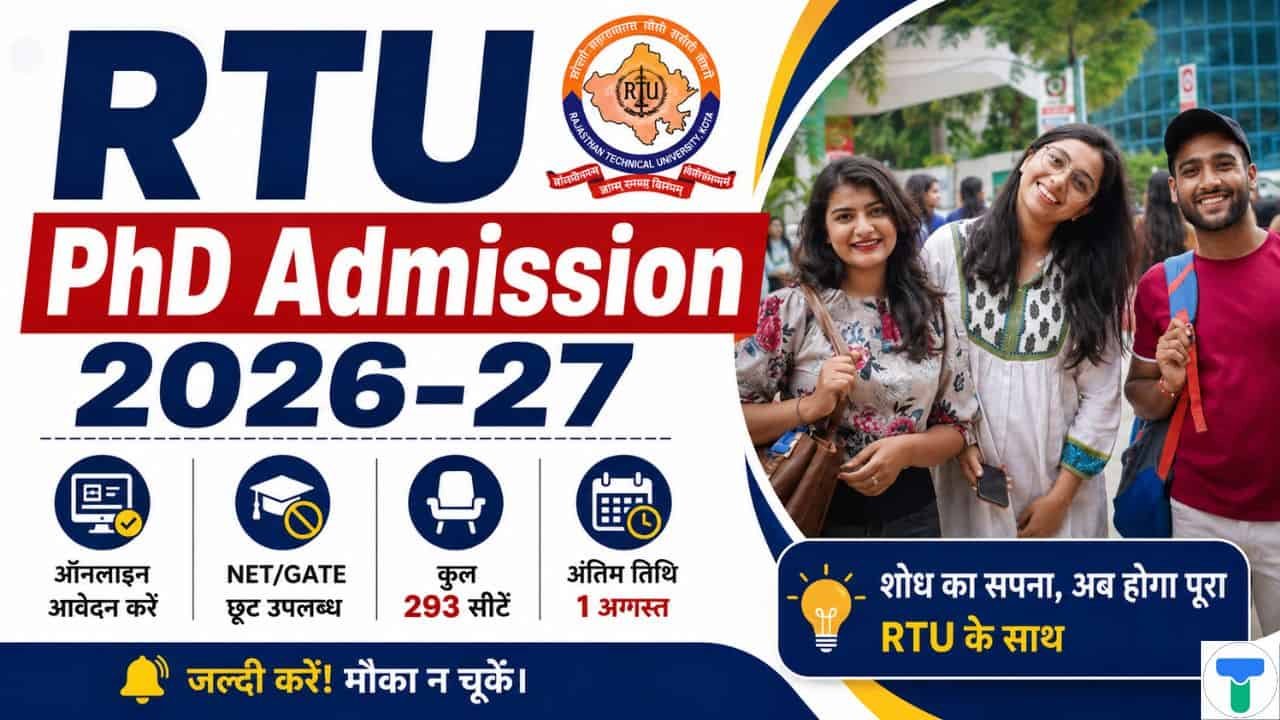
Rajasthan Technical University (RTU), Kota has opened applications for PhD admissions for the 2026-27 academic session with two significant changes that make this year’s cycle particularly noteworthy. For the first time in the university’s history, PhD programmes are being offered in Science (Physics, Chemistry, Mathematics) and Arts and Humanities (English, History, Political Science, Economics), expanding beyond its traditional engineering and technology stronghold. Additionally, candidates who have qualified UGC-NET, CSIR-NET, GATE, SEED, or Rajasthan SET will be exempted from the written entrance examination and admitted on the basis of their national exam score and interview alone.
Why This Year’s RTU PhD Admission Is Different
RTU was established in 2006 as a technical university, primarily focused on engineering, management, and technology education. Until 2025-26, the PhD programme was restricted to these domains. The 2026-27 expansion into Science and Humanities is a direct response to both the National Education Policy 2020’s emphasis on interdisciplinary research and the university’s strategic decision to broaden its research scope.
Vice Chancellor Prof. Nimit Ranjan Chaudhary has confirmed that full-time PhD scholars at university departments will receive financial assistance, making this an attractive option for research aspirants who want a structured fellowship along with their doctoral degree.
Key Admission Details at a Glance
| Particulars | Details |
| University | Rajasthan Technical University (RTU), Kota |
| Session | 2026-27 |
| Total PhD Seats | 293 |
| Number of Departments | 18 |
| Application Start | Already open |
| Last Date to Apply | August 17, 2026 |
| Application Fee | Rs. 3,540 |
| Exemption for NET/GATE/SET | Written exam not required |
| Official Portal | rtu.ac.in |
New Disciplines Added for 2026-27
The most historic change in this admission cycle is the addition of Science and Humanities disciplines under the newly constituted Humanities and Basic Sciences department. PhD research will now be available in the following subjects for the first time at RTU.
Science Subjects: Physics, Chemistry, Mathematics
Arts and Humanities Subjects: English, History, Political Science, Economics
This expansion aligns RTU with the UGC’s push for multidisciplinary research environments within technical universities, and creates new pathways for postgraduate students in these subjects who are seeking research opportunities at a state technical university rather than a traditional university.
Department-Wise Seat Distribution
| Department | PhD Seats |
| Electronics Engineering | 61 |
| Electrical Engineering | 42 |
| Management Studies | 44 |
| Computer Science and Engineering | 45 |
| Nano Technology | 38 |
| Civil Engineering | 24 |
| Mechanical Engineering | 25 |
| Renewable Energy | 25 |
| Computer Applications (MCA) | 32 |
| Textile Engineering | 11 |
| Chemical Engineering | 2 |
| Humanities and Basic Sciences | Seats to be announced |
| Total | 293 |
Electronics Engineering has the highest seat count at 61, reflecting RTU’s traditional strength in this domain.
Selection Process: Three Tracks Based on Qualification
RTU has implemented a three-tier selection system that rewards prior achievement in national-level qualifying exams.
Track 1: JRF Holders (Highest Priority)
Candidates who have qualified UGC-NET with JRF or CSIR-NET with JRF will receive 100 percent weightage in the interview and will be given first priority in the admission list. No written entrance test is required. JRF holders are the most preferred candidates across all departments.
Track 2: NET, GATE, SEED, or SET Qualified Candidates
Candidates who hold a valid UGC-NET (without JRF), CSIR-NET, GATE, SEED, or Rajasthan SET score (from 2023 onwards) are exempt from the RTU-DET 2026 written exam. Their selection will be based on a formula of 70 percent national exam score plus 30 percent interview marks.
This exemption is a major policy shift that significantly benefits working professionals or candidates who have already invested time preparing for and qualifying national examinations. It also streamlines the admission process and reduces the evaluation burden on the university.
Track 3: RTU-DET Written Entrance Test
Candidates who do not hold a NET, GATE, SEED, or SET qualification must appear in the RTU Doctoral Entrance Test (RTU-DET 2026). The exam structure is as follows.
Total Questions: 100 MCQs in 150 minutes (2.5 hours). Paper I covers 50 questions on Research Methodology. Paper II covers 50 subject-specific questions from the candidate’s discipline. Minimum qualifying marks are 50 percent for General category and 45 percent for SC, ST, OBC (Non-Creamy Layer), MBC (Non-Creamy Layer), EWS, and Differently-abled candidates.
Financial Support: Three Fellowship Options
RTU has made full-time PhD at its university departments financially viable through a structured financial support system.
University Research Assistantship (URA)
Full-time PhD scholars in Engineering, Nano Technology, and Management departments will receive Rs. 25,000 per month through the University Research Assistantship. This applies to 28 designated seats across these departments.
AICTE Doctoral Fellowship
Full-time PhD scholars in AICTE-approved branches who are eligible for this fellowship will receive:
- Rs. 37,000 per month as JRF during the first two years of research
- Rs. 42,000 per month as SRF after the first two years
- Rs. 15,000 annual contingency grant for research-related expenses
- HRA as per applicable government norms
This fellowship structure is competitive with CSIR and DST fellowships and makes RTU an attractive research destination for engineering and technology research scholars.
Eligibility Criteria
Master’s degree from any recognised university in the relevant discipline is the minimum educational requirement. The minimum percentage required is 50 percent for General, EWS, and OBC Creamy Layer candidates and 45 percent for SC, ST, OBC Non-Creamy Layer, MBC Non-Creamy Layer, and Differently-abled candidates.
For the new Humanities and Sciences disciplines, the corresponding Master’s degree in the specific subject (MA in English, MA History, MA Economics, MSc Physics, MSc Chemistry, MSc Mathematics) is required.
How to Apply
- Visit RTU Official Website rtu.ac.in and navigate to the PhD Admissions 2026-27 section
- Register as a new user if you do not have an existing account
- Fill in the online application form with your personal, academic, and qualifying exam details
- Upload required documents including master’s degree marksheets, NET/GATE/SET scorecard (if applicable), and identity proof
- Pay the application fee of Rs. 3,540 through the available online payment methods
- Submit the form and download the confirmation for your records
For RTU-DET exam preparation, the syllabus for Research Methodology and subject-specific papers is available on the RTU website.
Frequently Asked Questions (FAQs)
Q1. My GATE score is from 2024. Is it valid for RTU PhD admission 2026-27?
GATE scores are typically valid for three years from the year of the examination. A GATE 2024 score is valid through the 2026-27 academic cycle, which means you qualify for the NET/GATE exemption track at RTU for this admission round. However, it is always advisable to check the official notification at rtu.ac.in to confirm the specific year cutoff mentioned for GATE score validity, since RTU specifies SET validity from 2023 and the same year-based criteria may apply to GATE as well.
Q2. I have an MA in Economics and want to do PhD in RTU’s newly added Humanities stream. Do I need a technical background?
No technical background is required for the newly added Humanities and Basic Sciences disciplines at RTU. Your MA in Economics from a recognised university with the required minimum marks is sufficient to apply for PhD in Economics. The RTU-DET exam for Humanities disciplines will test Research Methodology and subject-specific Economics knowledge, not engineering or technology content. However, since this is the first year RTU is offering PhD in these subjects, check rtu.ac.in for specific supervisor availability and research areas before finalising your application.
Q3. Can I apply for PhD at RTU under both the NET-exempt track and also give the RTU-DET as a backup?
No. The selection tracks are mutually exclusive based on your qualification. If you hold a valid UGC-NET, CSIR-NET, GATE, SEED, or Rajasthan SET score, you fall into Track 2 and are automatically exempt from RTU-DET. You do not have the option to additionally appear in the written test. Conversely, if you do not hold any of these qualifications, you must appear in RTU-DET to be considered. Your application on the RTU portal will route you to the appropriate track based on the qualifying exam credentials you submit.
Q4. Is the Rs. 25,000 URA stipend available to all full-time PhD students or only to a specific number?
The University Research Assistantship of Rs. 25,000 per month is available only for full-time PhD students enrolled in University Departments (not affiliated research centres) in the Engineering, Nano Technology, and Management disciplines. Only 28 designated seats across these departments carry the URA benefit. Seats without URA will not receive this stipend. If you want to be eligible for URA, check the department-wise list of URA-eligible seats in the official RTU PhD brochure at rtu.ac.in before selecting your department preference.
