
Today is the day nearly 22.7 lakh medical aspirants across India have been anxiously waiting for. The Re-NEET UG 2026 examination is being held this afternoon from 2:00 PM to 5:15 PM, after the original exam conducted on May 3, 2026 was cancelled following widespread paper leak reports. For students and parents, finishing the exam today might feel like the end of the journey, but the truth is that the real process of securing a medical seat is only just beginning. Admission is never decided by your NEET score alone. It depends on your rank, the category-wise cutoff, and how well you navigate the counselling process that follows.
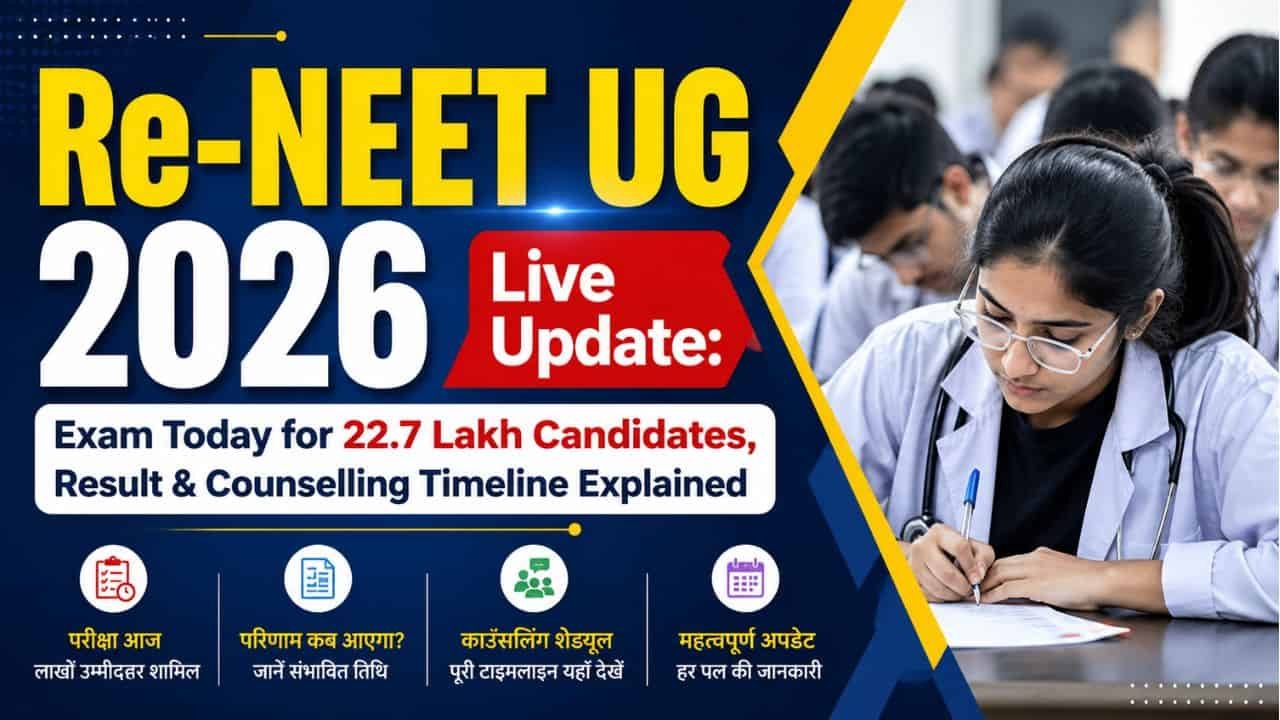
Here is everything you need to know about what happens after today’s exam, from result expectations to the complete counselling roadmap.
Why Re-NEET Is Being Held: A Quick Background
The original NEET UG 2026 exam was conducted offline on May 3, 2026. Shortly after, reports of paper leaks emerged from multiple exam centres, leading the National Testing Agency (NTA) to cancel the exam entirely on May 12, 2026. This decision affected approximately 22.79 lakh students nationwide. The Government of India ordered a CBI investigation into the matter, and NTA was directed to conduct a fresh examination on new dates.
To make the re-exam more secure and comfortable, NTA introduced a few changes this time. The exam duration structure was adjusted, and the number of rough work pages within the question booklet was increased to four, giving candidates more room to work through calculations and diagrams comfortably.
Importantly, no candidate needed to register again for the re-exam. All existing application details, candidature, and exam city preferences carried forward automatically. The original exam fee is being refunded by NTA, and a fresh admit card along with a city intimation slip was issued before today’s exam.
Re-NEET 2026: Key Facts at a Glance
| Particulars | Details |
| Original Exam Date | May 3, 2026 (Cancelled) |
| Reason for Cancellation | Paper leak reports, CBI investigation ordered |
| Re-Exam Date | June 21, 2026 |
| Exam Timing | 2:00 PM to 5:15 PM |
| Total Candidates | Approximately 22.7 lakh |
| Fresh Registration Needed | No |
| Fee Refund | Yes, original fee refunded by NTA |
What Happens After Today’s Exam: The Roadmap Ahead
Step 1: Answer Key and Result
Once today’s exam concludes, NTA will release the provisional answer key within a few days, followed by a window for candidates to raise objections if needed. The final answer key typically follows shortly after. Based on standard NTA timelines, where results are usually declared three to four weeks after the exam, the NEET UG 2026 result is expected in the third or fourth week of July 2026.
Step 2: MCC Counselling Begins
Once the result is declared, the Medical Counselling Committee (MCC) will release the official counselling schedule. Based on current estimates, this is expected to begin in the first week of August 2026. It is worth noting that because of the cancellation and re-exam, the entire MCC counselling timeline has effectively been pushed back by close to two months compared to a normal year.
| Stage | Expected Timeline |
| Re-NEET Exam | June 21, 2026 (Today) |
| Final Answer Key | Within days of the exam |
| NEET UG Result | Third or fourth week of July 2026 |
| MCC Counselling Begins | First week of August 2026 |
Four Important Things to Remember Before Counselling
1. Keep Your Documents Ready Now
Do not wait for the result to start preparing your documents. Keep the following ready well in advance: Class 10 and 12 marksheets, Aadhaar card, proof of date of birth, OBC-NCL or EWS certificate (if applicable), and your domicile certificate. It is critical that your name, parents’ names, and date of birth match exactly across all documents, since even minor mismatches can create complications during verification.
2. Understand the Two-Track Counselling System
NEET UG counselling operates through two separate and parallel tracks. The 15% All India Quota (AIQ) seats are counselled by MCC, where students from anywhere in the country can apply for seats in government medical and dental colleges nationwide. The remaining 85% State Quota seats are counselled separately by each state’s own counselling authority, and these are generally reserved for domicile candidates of that particular state. Students must track both portals independently, as they operate on different schedules and require separate registration.
3. Be Extremely Careful While Filling Choices
Choice filling is the single most consequence-heavy step in the entire counselling process. The seat allotment algorithm works strictly from top to bottom of your preference list. If you accidentally place an expensive private college above a better government college option, the system may allot you the private seat first, permanently costing you the chance at the government seat you actually wanted. Many students lose excellent opportunities purely due to careless choice ordering rather than rank limitations.
4. Know the Round-Wise Process
As per MCC rules, candidates can re-participate in subsequent rounds if they are not satisfied with their allotment. Round 1 offers the first opportunity for seat allotment and admission. Round 2 gives candidates a second chance to either upgrade their seat or secure a new one. The Stray Vacancy and Special Rounds fill any seats that remain vacant after the earlier rounds, based on need. One critical rule to remember is that once Round 2 concludes, no seats are returned to the states, meaning the seat matrix becomes largely fixed at that point.
Security Deposit Rules You Should Know
MCC counselling requires candidates to pay a security deposit of Rs. 10,000, while counselling for Deemed Universities can require a deposit of up to Rs. 2 lakh. This deposit acts as a commitment mechanism. A free exit is available in Round 1, meaning candidates can withdraw without losing their deposit. However, from Round 2 onward, withdrawing after accepting a seat can lead to forfeiture of the security deposit, so candidates should be fully certain before confirming a seat in later rounds.
Total Seats Available Through NEET UG Counselling
NEET UG counselling will provide admission to 1,29,603 MBBS seats across 824 medical colleges in India. Of these, approximately 417 are government colleges, offering around 59,000 government MBBS seats. Beyond MBBS, the broader NEET ecosystem also covers admission to BDS, AYUSH courses (BAMS, BHMS, BUMS), and BSc Nursing programmes through the same counselling infrastructure.
How Difficulty Level Affects Cutoff: Learning From Past Years
NEET cutoffs are never fixed numbers; they shift every year based on how difficult the paper was. In 2024, the paper was relatively easy, which pushed cutoffs higher since more students scored well. In contrast, 2025 saw a tougher paper, where the topper’s score stood at 686, and a score of around 610 was considered a safe benchmark for government college admission. This pattern shows why candidates should focus on their rank and percentile rather than obsessing purely over raw marks once today’s re-exam concludes.
Frequently Asked Questions (FAQs)
Q1. I appeared for the original NEET exam on May 3 before it was cancelled. Do I need to do anything extra to appear in today’s re-exam?
No, you do not need to take any extra action. Your original application, candidature details, and exam city preference automatically carried forward to the re-exam. A fresh admit card and city intimation slip were already issued to you before today’s exam date. You simply needed to appear at your allotted centre today with the new admit card.
Q2. Will I get a refund for the fee I paid for the original May 3 exam?
Yes. Since the original exam was cancelled by NTA due to circumstances beyond any candidate’s control, the fee paid for the original registration will be refunded by NTA. You were not required to pay any additional fee to appear in today’s re-exam.
Q3. With counselling now delayed by nearly two months, will the total number of counselling rounds reduce?
Not necessarily. While the overall calendar has shifted later into the year, MCC typically completes the required four to five rounds, including the Stray Vacancy round, before the academic session begins. However, the compressed timeline means each stage, including result, document verification, and reporting, may move faster than usual once it starts, so candidates should be ready to act quickly without delays once each stage opens.
Q4. I am worried that even after the re-exam, my preparation might not match the new pattern. What should I keep in mind for the actual exam day?
Today’s NEET pattern remains MCQ-based with the same syllabus as before, so no fresh preparation strategy is needed. The only practical changes were an increase in rough work pages and the confirmed timing of 2:00 PM to 5:15 PM. Candidates should focus on time management within this window, attempt questions they are confident about first, and use the additional rough pages wisely for calculations in Physics and Chemistry numericals.
As the exam concludes today, candidates should immediately shift focus toward organising their documents and understanding the counselling process described above. Stay updated only through official sources: visit NTA NEET Portal at neet.nta.nic.in for exam date, admit card, answer key, and result updates, and check MCC Portal at mcc.nic.in for counselling schedule, seat matrix, and allotment results. Avoid relying on social media or unverified sources for any update related to your medical admission journey.
