
If your child is currently studying in Class 5 during the 2026-27 academic year, one of the most important application deadlines of their school career is just a few weeks away. The Navodaya Vidyalaya Samiti (NVS) officially released the JNVST 2027 notification on July 6, 2026, opening online registrations for Class 6 admission to Jawahar Navodaya Vidyalayas (JNVs) for the 2027-28 academic session. The last date to apply is July 31, 2026, and the application is completely free of cost.
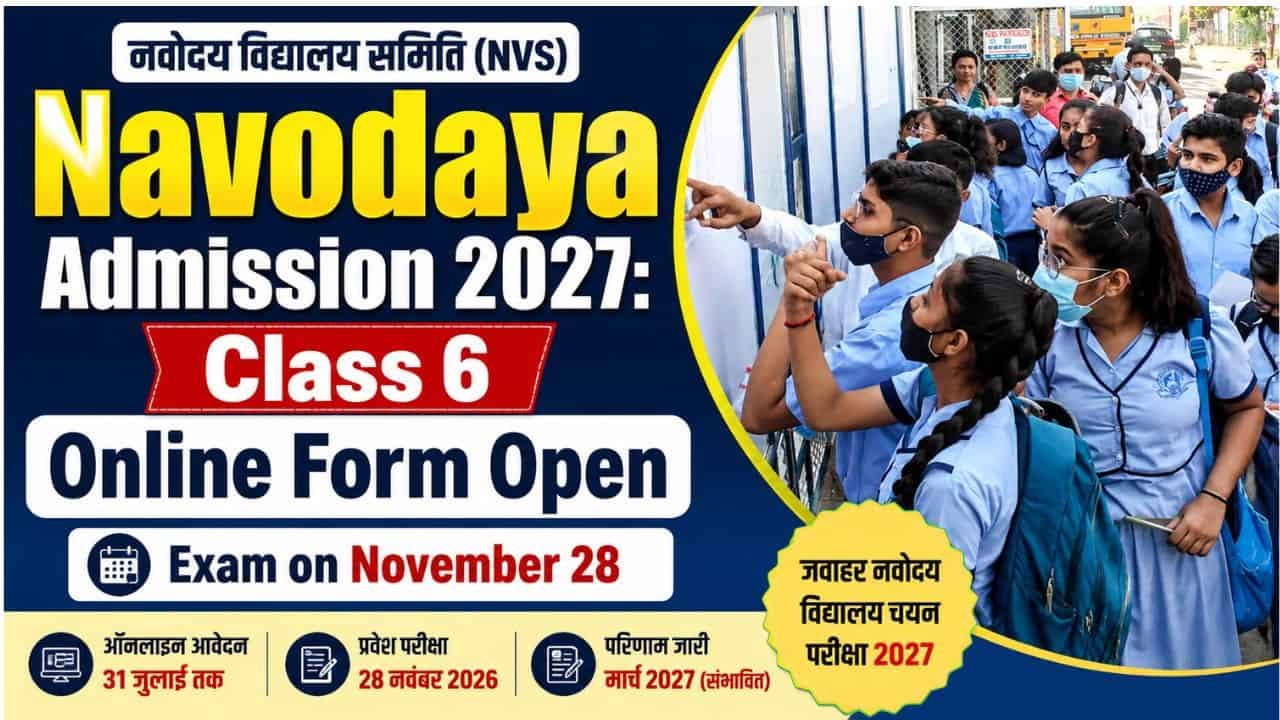
The selection test is scheduled for November 28, 2026, and results are expected by March or April 2027. This is the only pathway to admission in JNVs, making it essential for eligible students to apply without delay.
What Are Jawahar Navodaya Vidyalayas?
Jawahar Navodaya Vidyalayas are fully residential, co-educational schools affiliated with CBSE and run by the Government of India under the Ministry of Education. They were established with a single clear mission: to identify and nurture talented students from rural India, especially those who may not have access to quality schooling, and provide them with world-class education entirely free of charge.
Students admitted to JNVs receive free education, hostel accommodation, three meals a day, school uniforms, textbooks, notebooks, sports facilities, and opportunities across co-curricular activities. The central government fully funds these schools. Currently, 665 JNVs are operational across 27 states and 8 Union Territories in India, with each school admitting a maximum of 80 students per district.
JNVST 2027: Important Dates at a Glance
| Event | Date |
| Official Notification Released | July 6, 2026 |
| Online Registration Begins | July 7, 2026 |
| Last Date to Apply | July 31, 2026 |
| Selection Test Date | November 28, 2026 |
| Result Declaration | March or April 2027 |
Eligibility Criteria: Who Can Apply?
Academic Requirement
The student must be studying in Class V during the 2026-27 academic year in a Government, Government-Aided, or Government-Recognised school. Students who passed Class V in a previous academic session or are repeating Class V are not eligible. The candidate must have completed one full academic session each in Classes III, IV, and V without skipping any grade.
Age Requirement
The candidate must be born between May 1, 2015 and July 31, 2017, both dates inclusive. This age window is fixed and applies equally to all categories. There is no age relaxation for SC, ST, OBC, or Divyang candidates. This is a strict and non-negotiable requirement.
District Residency Rule
A student can only apply for the JNV in their home district. If a student is studying in a school located in a neighbouring district, that school must be within 10 km of the student’s residential address, and the application must be made for the JNV in the district of residence, not the district of the school. The candidate must be a bonafide resident of the district for which they are applying.
One-Attempt Rule
A candidate can appear in JNVST only once in their lifetime. Students who have appeared in any previous JNVST are not eligible to apply again.
Selection Test Pattern: What the Exam Looks Like
The JNVST is an OMR-based, offline, pen-and-paper examination. The paper is divided into three sections.
| Section | Questions | Marks |
| Mental Ability | 40 | 50 |
| Arithmetic | 20 | 25 |
| Language | 20 | 25 |
| Total | 80 | 100 |
The total duration is 2 hours (120 minutes). There is no negative marking. Unattempted questions carry neither penalty nor reward. Answers must be marked on the OMR sheet using only a Blue or Black Ball Point Pen.
The question paper is available in multiple regional languages. Candidates choose their preferred language at the time of application, and no change is permitted after submission. Candidates must reach the examination centre before 11:00 AM on the day of the test. No one will be admitted after the scheduled start time.
Rural and Urban Quota
At least 75 percent of seats in every JNV are reserved for candidates from rural areas. Rural or urban status is determined based on the location of the school where the candidate studied Classes III, IV, and V. If a student attended schools located in a census rural area for all three classes, they are considered a rural candidate. Urban candidates are eligible to apply but compete only for the remaining 25 percent of seats.
Documents Required to Apply Online
Keep these documents ready in JPG format (file size between 10 KB and 100 KB) before starting the application.
- Recent passport-size photograph of the student
- Student’s signature
- Parent or guardian’s signature
- Certificate from the school head verifying that the student is studying in Class V during 2026-27
- Date of Birth proof (birth certificate or Class X certificate)
- Residence certificate of the district where the application is being submitted
- Caste certificate (if applicable for SC or ST category)
- Aadhaar number (or Residence Certificate details if Aadhaar is not available)
How to Apply Online Step by Step
The entire application process is online and free of charge. No offline forms are accepted.
- Visit Navodaya Official Portal navodaya.gov.in or the registration portal at cbseitms.rcil.gov.in
- Read the eligibility criteria and the official prospectus carefully before proceeding
- Fill in the student’s personal and academic details including name, date of birth, district, school, and class
- Enter the Aadhaar number or other residence proof details
- Upload all required documents in JPG format within the specified file size limits
- Select the preferred language for the question paper during the registration step itself, since no change is allowed later
- Review all entered details thoroughly before submitting
- Submit the form and save a printed copy of the confirmation for future reference
What Happens After the Exam?
Once the November 28 exam is conducted, NVS will release the JNVST 2027 result on its official website in March or April 2027. Students can check the result by entering their roll number and date of birth on the portal. The result is also released regionally through state-wise merit lists. Selected candidates will then be called for document verification and medical examination before final admission is confirmed for the 2027-28 session.
Frequently Asked Questions (FAQs)
Q1. My child is studying in Class 5 in a private unaided school. Can they apply for JNVST 2027?
No. Eligibility for JNVST is restricted to students studying in Government schools, Government-Aided schools, or Government-Recognised schools. Students in fully private, unaided schools are not eligible to apply, regardless of their academic merit or family’s financial situation. If your child is in a private school without government recognition, they cannot appear in JNVST 2027.
Q2. My child was born on August 1, 2017. Does this make them ineligible since the cutoff is July 31, 2017?
Yes, unfortunately. The date of birth window for JNVST 2027 is May 1, 2015 to July 31, 2017, both dates inclusive. A child born on August 1, 2017 falls one day outside this window and is therefore ineligible to apply for JNVST 2027. There is no age relaxation of any kind, not even for SC, ST, OBC, or Divyang candidates. Your child may be eligible for JNVST in the following year’s cycle if they meet the Class V enrollment and age requirements at that time.
Q3. We live in one district but my child studies in a school in the neighbouring district. Which JNV can we apply for?
You must apply for the JNV in your district of residence, not the district where the school is located. The exception applies only if the school in the neighbouring district is within 10 km of your home address. In that case, the application must still be for the JNV in the residential district. If the school is more than 10 km away from your residence, the application will only be valid if the student actually studies in the district of residence.
Q4. My child already appeared in JNVST last year but was not selected. Can they try again this year?
No. JNVST has a strict one-attempt-only rule. A candidate who has previously appeared in any JNVST examination is permanently ineligible to apply again, regardless of whether they were selected or not. This rule applies to all candidates without exception. If your child appeared in JNVST last year, they cannot participate in JNVST 2027 or any future JNVST cycle.
