
India’s most competitive engineering admission process has officially entered its first real round. JoSAA (Joint Seat Allocation Authority) 2026 counselling is now live, and the Round 1 seat allotment is scheduled for June 13, 2026 at 10 AM on josaa.nic.in. With nearly 2 lakh students having locked their choices and over 27 crore preferences submitted, this year’s counselling is the largest and most competitive in JoSAA’s history.
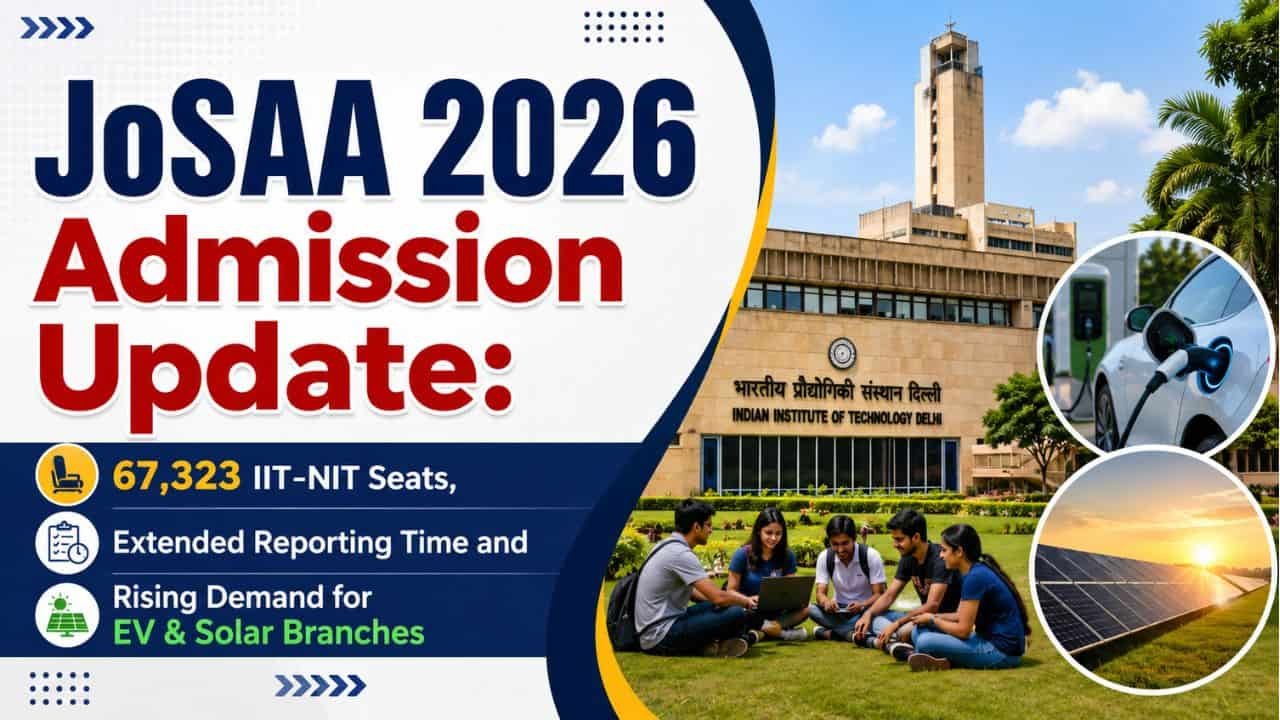
Two major developments stand out this year: a significant expansion in the total number of seats, and an unprecedented shift in branch preferences, with EV, Solar, and Semiconductor-related branches emerging as the new favourites alongside traditional core engineering.
JoSAA 2026: What You Need to Know First
JoSAA is the centralised counselling process managed by the Ministry of Education for admissions to India’s top government engineering institutions. Through a single online platform at josaa.nic.in, qualified JEE candidates are allotted seats based on their rank, category, and filled preferences.
This year, 138 institutes are participating in JoSAA counselling, including 23 IITs, IISc Bengaluru, 31 NITs, IIEST Shibpur, 26 IIITs, and 56 Other-GFTIs. A significant addition this year is IISc Bangalore, which is participating in JoSAA for the first time to offer admission to its 4 BTech programmes.
Record Seat Expansion in 2026: 4,470 New Seats Added
JoSAA 2026 has brought the biggest year-on-year seat increase in recent memory. The total seat count has jumped from 62,853 in 2025 to 67,323 in 2026, adding 4,470 new seats across the board.
| Institute Type | 2025 Seats | 2026 Seats | Seats Added |
| IITs | 18,160 | 18,951 | +791 |
| NITs | 24,525 | 25,162 | +637 |
| IIITs | 9,940 | 11,518 | +1,578 |
| GFTIs | 10,228 | 11,692 | +1,464 |
| Total | 62,853 | 67,323 | +4,470 |
The highest growth has been recorded in IIITs, which added 1,578 new seats, followed by GFTIs with 1,464 additional seats. This expansion reflects the growing national push toward technology and emerging engineering disciplines. The number of GFTIs has also increased from 47 in 2025 to 56 in 2026, bringing more regional institutions into the fold.
Why Reporting Time Was Extended from 5 to 14 Days
One of the most student-friendly changes in JoSAA 2026 is the extension of online reporting time after Round 1 allotment. In previous years, students had a maximum of 5 days to complete online reporting, which included fee payment and document uploading. This year, that window has been expanded to 14 days, running from June 13 to June 26, 2026.
The reason is directly linked to the CBSE OSM (On-Screen Marking) re-evaluation controversy. Since the majority of JoSAA participants come from the CBSE board, and thousands of Class 12 students are still awaiting re-evaluation results, JoSAA authorities made the decision to give these students adequate time to settle their board result issues before committing to an institute and paying fees. This is a rare and welcome accommodation that directly benefits students caught in the middle of the CBSE dispute.
JoSAA 2026 Round-Wise Schedule
| Round | Seat Allotment Date | Key Deadline |
| Round 1 | June 13, 2026 (10 AM) | Online Reporting: June 13 to June 26 |
| Round 2 | June 30, 2026 | Seat Withdrawal: July 1 to July 3 |
| Round 3 | July 6, 2026 | Seat Withdrawal: July 7 to July 8 |
| Round 4 | July 10, 2026 | Seat Withdrawal: July 11 to July 14 (Last chance for IIT and IISc) |
| Round 5 | July 16, 2026 | NIT+ Withdrawal: July 16 to July 20, Query Deadline: July 21 |
After Round 5, IIT and IISc counselling closes completely. For the NIT+ System (NITs, IIIT, IEST, and Other-GFTIs), students who receive a seat in Round 5 must pay the Partial Admission Fee (PAF) online between July 22 and July 24, 2026. Missing this payment deadline will result in automatic cancellation of the allotted seat. Any remaining vacant seats after all JoSAA rounds are filled through the CSAB Special Rounds.
2 Lakh Students Filed Over 27 Crore Choices
The scale of participation in JoSAA 2026 is historic. While Mock Allotment Round 1 saw 1,68,615 students, by the time Mock Round 2 was released, the number had grown by 30,329 to reach 1,99,944 students. Together, these students submitted an extraordinary 2,70,52,999 college and branch preferences.
Students who could not manually lock their choices before the June 11, 5 PM deadline had their last saved preferences auto-locked by the system, ensuring no candidate was left out of the process due to a missed deadline.
The Big Trend: Why EV, Solar and Semiconductor Branches Are Now Top Choices
Mock Allotment Round 2 revealed a striking shift in student preferences. Alongside traditional core branches like Computer Science, Mechanical, and Civil Engineering, students are now heavily prioritising branches connected to Electric Vehicles (EV), Solar Energy, and Semiconductor Manufacturing.
What Is Driving This Shift?
India’s National EV Mission is a major factor. The government’s push under schemes like FAME-II (Faster Adoption and Manufacturing of Hybrid and Electric Vehicles) and the Production-Linked Incentive (PLI) scheme for automotive and battery storage has created massive industry demand for engineers with expertise in Electrical, Electronics, and Power Systems. Students are responding to where the jobs are going to be.
Solar Energy boom is another powerful driver. India has set a target of 500 GW of renewable energy capacity by 2030, and the solar sector alone is projected to need hundreds of thousands of trained engineers in areas like photovoltaics, energy storage, and grid management. Engineering Physics and Electrical branches serve as direct entry points into this sector.
The global Semiconductor push has further shifted preferences. After the global chip shortage exposed India’s dependency on imported semiconductors, the government launched the India Semiconductor Mission, committing over Rs. 76,000 crore to build domestic chip manufacturing capacity. IITs, NITs, and IIITs have responded by opening new semiconductor-focused programmes and expanding Electronics and VLSI-related courses.
The result is visible in JoSAA choices: Electronics, Electrical, and Engineering Physics are now being preferred not just at IITs but also at NITs and IIITs, with students placing these branches ahead of Civil and Mechanical in many cases.
Eligibility: Who Can Participate in JoSAA 2026?
For IIT Admissions
Candidates must hold a valid JEE Advanced 2026 rank and must have been among the top 2.5 lakh qualifiers in JEE Main 2026. The minimum age requirement is a date of birth on or after October 1, 2001 (October 1, 1996 for PwD candidates).
For NIT, IIIT and GFTI Admissions
Candidates must hold a valid JEE Main 2026 rank and must have scored at least 75% marks in Class 12 with Physics, Chemistry, and Mathematics as core subjects. For SC, ST, and PwD candidates, the minimum is 65%. Alternatively, candidates must fall within the top 20 percentile of their respective board.
Both JEE Main and JEE Advanced qualifiers can register together and fill preferences for all participating institutes through a single login.
Understanding Freeze, Float and Slide: What Should You Choose?
After each round of seat allotment, every candidate must choose one of three options within the given deadline. Missing this window cancels the allotment entirely.
Freeze means you are satisfied with the allotted seat and wish to confirm it. You will not be considered for upgrades in subsequent rounds, but your seat is secured.
Float means you accept the current seat but want to be considered for a better college or branch in the next round based on your original preference order. If an upgrade is available, the system moves you automatically.
Slide means you want to be upgraded to a better branch within the same institute if a seat becomes available in subsequent rounds.
The safest strategy for most students is to Float in early rounds and Freeze only when satisfied or when approaching the final rounds.
How to Check Round 1 Allotment on June 13
Follow these steps to check your allotment result on the official portal.
- Visit JoSAA Official Portal at josaa.nic.in
- Click on the “Seat Allotment Result” link for Round 1
- Log in using your JEE Main or JEE Advanced application number and password
- Download your Seat Allotment Intimation Slip
- If allotted a seat, proceed with online reporting, fee payment, and document upload before June 26
No separate SMS or email intimation will be sent for seat allotment. All candidates must log in and check themselves.
Frequently Asked Questions (FAQs)
Q1. I forgot to lock my choices before June 11. What happens to my registration?
Your last saved preferences were automatically locked by the JoSAA system at 5 PM on June 11. You remain eligible for seat allotment based on those auto-locked choices. No manual intervention is required, but you should log in and verify which choices were saved before the allotment comes out on June 13.
Q2. I am a CBSE student whose re-evaluation result is still pending. Can I participate in JoSAA with my current Class 12 score?
Yes, you can participate in JoSAA 2026 with your current declared Class 12 marks. The 14-day extended reporting window specifically accounts for students in this situation. If your marks increase after re-evaluation and you become eligible for a seat you were previously unable to claim, you should contact JoSAA helpdesk immediately with your updated marksheet, as the process for accommodating such cases will be handled on a case-by-case basis.
Q3. What is the difference between Round 4 and Round 5 for IIT students?
Round 4, with its withdrawal window from July 11 to July 14, is the last round in which IIT and IISc candidates can withdraw their seat. After Round 4, IIT allotments become binding, and any withdrawal will mean complete exit from the IIT system. Round 5 on July 16 continues only for the NIT+ system (NITs, IIITs, IESTs, and GFTIs). IIT students must make their final decision by Round 4.
Q4. After JoSAA Round 5, what happens if I still do not get a seat?
Candidates who do not receive a seat after all five JoSAA rounds should immediately register for the CSAB (Central Seat Allocation Board) Special Rounds, which are held shortly after JoSAA concludes. CSAB fills vacant NIT, IIIT, and GFTI seats through special rounds including CSAB-NEUT (for candidates from North-East and Union Territories) and general special rounds. Keep tracking the official JoSAA and CSAB portals after Round 5 for further instructions.

1 thought on “JoSAA 2026 Admission Update: 67,323 IIT-NIT Seats, Extended Reporting Time and Rising Demand for EV & Solar Branches”